What did entrepreneurs learn in Nanhai, Japan in five years and three years?
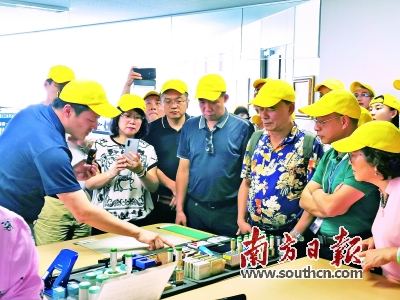
"I finished writing a pen in a week in Japan." Zhang Weiqiang, chairman of Foshan Zhongyuan Innovation Industry Co., Ltd. said. At the end of July, leading entrepreneurs from South China Sea entered Kyoto and Nagoya, Japan, and 26 leading entrepreneurs from South China Sea started a 7-day exchange training, focusing on Japanese century-old enterprises, lean production and enterprise management.
This is not the first time that entrepreneurs from South China Sea have come to Japan to exchange and study. In the past five years, three groups of entrepreneurs from South China Sea have gone to Japan. After combing the three trips, we can find that entrepreneurs in the South China Sea generally pay attention to the evergreen mystery of Japanese enterprises, the innovative survival password of manufacturing enterprises and the secret of enterprise management. In the short exchange and study, how did Nanhai entrepreneurs touch? What kind of feelings and sentiments do you have?
A century-old shop focuses on "being refined and strong"
A century-old enterprise is a key point that South China Sea entrepreneurs can’t avoid when they study in Japan, which is also a focus that Japan has attracted worldwide attention. Statistics show that there are 20,000 enterprises in Japan with a history of more than 100 years, and there are 5,586 enterprises that have been in business for more than 200 years in 41 countries around the world, of which 3,146 are concentrated in Japan, which is more than half of the total.
This kind of data makes Japan well-deserved to become the country with the largest number of longevity enterprises in the world, and also attracts global attention and focus. In the three exchange studies in the past five years, the century-old enterprise is a compulsory course for enterprise training in Nanhai.
Take the visit of Morita Machinery Industry Co., Ltd. (hereinafter referred to as "Morita Machinery") as an example. This enterprise established in 1919 just turned 100 this year. Besides in Japan, Morita has also set up a company in Suzhou, China.
Morita Taihong is the third generation president of Morita Production Machine. As a small and medium-sized manufacturing enterprise, Morita Production Machine mainly manufactures copper bar extension machinery, and it is the only enterprise in the world that integrates hard surface cutting, milling cutter and special grinder for milling cutter. At present, its product application fields include the Japanese Mint, the development of copper conductivity for hybrid electric vehicles, and the miniaturization development of electronic components.
Referring to how to carry on the inheritance among the three generations, Morita Taihong believes that the key lies in "in the past 100 years, Morita has only insisted on one thing — — Mechanical manufacturing. " In this process, being bigger is not their main purpose. Even after 100 years of development, there are only 80 employees in the field production machine at present, with an output value of 2.5 billion yen.
It is worth mentioning that most of the century-old shops in Japan are small and medium-sized enterprises, all of which have a capital of less than 100 million yen or fewer than 300 employees. In Japan, about 97% of enterprises belong to this category. In the eyes of many managers of Japanese century-old shops, the sustainability of enterprises is greater than profits, and the satisfaction brought by meeting customers’ needs and making employees happy and motivated is greater than the profits earned by enterprises.
It is a common feature of many century-old shops in Japan to persist in doing a deep job in one field, not only in the field. "The output value of Japanese small enterprises visited this time is generally not high, but they have one thing in common, that is, concentration." Pan Weishen, the chairman of Guangdong Huachang Aluminum Factory Co., Ltd. believes that it is more meaningful to be refined, strong and specialized than to be big, otherwise the enterprise can only be a puffy fat man, not really strong.
This view has also been recognized by a group of entrepreneurs in the South China Sea. "In terms of scale, enterprises in Nanhai are not smaller than Japanese SMEs, and even many of our enterprises are bigger than them, but we are obviously not enough in depth and concentration." Xie Dahai, managing director of Guangdong Hemei Ceramics Co., Ltd. believes that if the enterprise is not specialized enough and deep enough, it is easy to get lost.
"The century-old enterprise that visited Japan has strengthened my confidence in building a century-old enterprise." Liang Fengyi, chairman of Guangdong Zhaoxin Group Co., Ltd. said that Zhaoxin Group has gone through a history of 55 years, and compared with Japanese enterprises in the past century, Zhaoxin Group will continue to adhere to industry and innovation in the future.
Continue to seek "innovation" in "keeping business"
In addition to being refined and strong, there is another important secret to make Japanese family businesses last for a hundred years — — Continuous innovation. By combing the enterprises that have visited Japan for three times in the past, we can find that they all have a common feature, that is, they have grafted the genes that attach importance to family and consanguinity in eastern culture with the enterprise system originating from the West, forming a unique enterprise culture and management style.
"The reason why these century-old shops can continue to operate is that they continue to innovate and succeed. While continuing the business model of the previous generation, they have been insisting on innovation outside the externally visible management and operation model." Professor Kaichi Maekawa of the School of Business Administration of Kyoto University has been studying Japanese century-old shops for a long time. He found that many century-old shops are continuous innovative and successful enterprises.
For example, Fushouyuan, which was founded in 1790 and engaged in the production and manufacture of green tea, chose to jointly develop the cool beverage market with iemon after noticing the great market attraction in the field of cool beverages; Elekiya Co., Ltd. was in trouble when the 14th generation of heirs took over, and finally in 1999, through innovation, the handmade works lying in the warehouse at the beginning of Showa were reproduced, which brought the enterprise back to life. Yojiya Co., Ltd. developed oil-absorbing paper from a cosmetics grocery store through innovation, and started the operation attempt of coffee shop in the form of common concepts … …
"When my grandfather started his business, he worked as an iron works, but now we are engaged in the production of automobile precision parts. But in the past 70 years, on the one hand, we have always focused on cutting and grinding, and on the other hand, we have made changes around these two fields." Kato Zhangdian is the president of AVEX Co., Ltd. and the third generation descendant of the company. They have always maintained a sense of crisis in the process of enterprise development.
"Most of our current products are auto parts, but when hydrogen energy vehicles are produced in large quantities, our business may be greatly affected." Just like this, at present, Zhangdian Kato is applying technology to agricultural machinery and construction machinery.
"Why have many century-old enterprises in Japan been passed down from generation to generation, some for more than a thousand years? How did they do it? I think in the final analysis, what we think of as inheritance often thinks that the core is wealth, but in Japan, the core of their inheritance along the way is not wealth but family spirit, which is the inheritance of technology and craft related to the cause. " Xiao Libiao, president of Mona Lisa Group Co., Ltd. believes that these century-old shops will not ask their successors to make a lot of money or make the enterprise large, but hope that they will specialize in the enterprise and pass on the corporate brand.
This has made many South China Sea entrepreneurs have deeper thinking. "In fact, in the past 30 years, I think Japanese companies are hiding their light." Ye Weizhong, chairman of Foshan Nanhai Keri Ultrasonic Electronics Co., Ltd. believes that Japan’s "lost 30 years" is not really lost. Many century-old enterprises have experienced this "lost 30 years", but in fact they are quietly transforming. "This exchange and study in Japan has strengthened the determination and confidence to lay a solid foundation for the enterprise."
"Incredible" Fine Management Landing
Ichihara Yongyi, a special teaching assistant at the School of Management, Kyoto University, introduced that there are two main schools of refined management mode in Japan, one is the amoeba management mode created by Kyocera, and the other is the cost management mode represented by Toyota Motor.
In fact, since the 1990s, there are not a few South China Sea enterprises that have learned refined management from Japan. Besides the government’s promotion, there are countless trainings organized by intermediaries. However, when a group of South China Sea entrepreneurs came to Japan to refer to the fine production of local enterprises on the spot, they would still be shocked by their orderly management.
Also in the field of production, the refined production management of this century-old invisible champion enterprise pursues that employees’ desks have no drawers, all office supplies are common, and each item has its own specific place to store; The standing meeting system is implemented and an alarm clock is set for half an hour, thus improving the efficiency of the meeting; The cleaning of the office area and the production workshop is done by the employees themselves, etc. … …
In addition to refined management, the inventory and cost control of Japanese companies have impressed many entrepreneurs in the South China Sea. AVEX Co., Ltd. pursues Toyota production mode (TPS), which does not adopt forecast or planned production in production, and only organizes production according to the order requirements and order after receiving customer orders, so as to achieve the purpose of reducing inventory backlog. "Our whole factory has only one day’s inventory, so our production must be Just in time." Kato Zhangdian said.
This shocked entrepreneurs in the South China Sea. "As a manufacturer of ceramics, our inventory has dropped from the original 3 months to 2 months, and finally it has dropped to the current 70 days. However, compared with their inventory of only one day, we feel incredible." Xiao Libiao said.
"Japan’s refined management is really worth learning, and we are also implementing it, but we can’t copy the Japanese management model and must implement it according to the actual situation of the enterprise." Gao Yaoting, chairman of Foshan Jingdaxin Hardware and Electrical Appliances Co., Ltd. said.
The first thing that is reflected behind this is the cultural difference. Ye Weizhong believes that the cultural foundation is a very important condition for Nanhai enterprises to learn Japanese management. If they don’t do a good job of corporate cultural foundation and form an atmosphere, but simply copy the management models of Amoeba and Toyota in Japan, they may all be useless in the end. "Just like your soil is not ready, transplanting trees directly can never thrive." Ye Weizhong said.
"Although the exchange and study in Japan is very short, every entrepreneur will be touched, think, and combine the reality of the company to find the answer." Guan Rundan, chairman of Foshan Nanhai Federation of Industry and Commerce and president of Guangdong Xinruncheng Ceramics Co., Ltd., believes that enterprises in Nanhai have developed rapidly and made great achievements after the reform and opening up. However, in the new journey of high-quality development, we must have a sense of urgency and a more precise positioning in order to pass on the enterprises better.
Text/Photo: Nanfang Daily reporter Li Huijun