George Gallo Wei, a former British MP: The United States and Japan are engaged in "the Asian version of NATO" with sinister intentions!
[Global Times reporter Li Aixin] "The United States is ready to let Ukrainians and Europeans shed their last drop of blood." George Gallo Wei, a former British MP, said this after the outbreak of the conflict between Russia and Ukraine last year. One year before the conflict broke out, the anti-war campaigner, who had been a member of parliament for about 30 years, once again accepted an exclusive interview with the Global Times reporter. He still believed that with the intervention of the West, Russia and Ukraine could not hold diplomatic negotiations to resolve the crisis, which would lead to "the price paid by Ukraine is getting higher every day." Speaking of the US’s attempt to win over Japan and other countries to engage in an "Asian version of NATO", galloway believes that this intention is very sinister, but for China, NATO’s "paper tiger" is nothing to be afraid of.
Global Times: What stage do you think the Russian-Ukrainian conflict has developed? What is the biggest obstacle for both sides to end the conflict through negotiation and diplomacy?
Galloway: The current situation can be likened to the Battle of Stalingrad. Early February 80 years ago was the turning point of the Second World War. This conflict could have been avoided by diplomatic means before February 24 last year, or resolved within the first few months of the conflict. However, the west did not allow Russia and Ukraine to negotiate, and they dismissed a possible peace agreement. This is why I often say that the current political leadership in Ukraine is not strong enough to withstand the pressure exerted by the West. I want to stress once again that the west is prepared to let Ukrainians shed their last drop of blood, not their own. The price paid by Ukraine is getting higher every day.
There are preconditions for ending the conflict between Russia and Ukraine, and Ukraine’s non-participation in NATO is one of them. Although Ukraine is not a member of NATO, NATO is everywhere in Ukraine. If the two sides negotiate, this will definitely be involved in the diplomatic agreement. Therefore, the prerequisite is not only that Ukraine will never apply to join NATO, but also that NATO will never infiltrate Ukraine, whether it is to provide weapons, personnel or engage in geostrategic schemes. Ukraine must be a truly neutral country. I think this is hard to imagine now. If nothing else, the west has given Ukraine hundreds of billions of dollars in military assistance in this conflict, and they will not give up this "investment" easily.
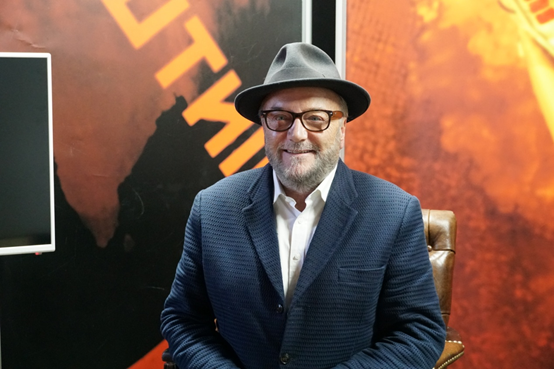
Former British MP George Gallo Wei
Global Times: You just mentioned that NATO countries led by the United States are constantly providing weapons to Ukraine. Recently, some critics have described the trend of countries such as the United States, Germany and Britain to aid Ukrainian tanks as a possible "game changer." In addition, there are voices saying that Europe and the United States want to give Ukraine more and better weapons. What do you think of this?
Galloway: Those tanks will definitely not be "game changers". First of all, whether in Iraq war or Afghanistan war, American main battle tanks failed to effectively confront local militants or roadside improvised explosive devices. The Americans agreed that the M1 "abrams" main battle tank given to Ukraine would remove some important armor protection. They didn’t want to take the risk that this armor would fall into the hands of the Russians. They were afraid that Russia would get relevant technical secrets. The tanks provided by the United States are not only incomplete, but also will not "arrive" soon. Moreover, the number of aid Ukrainian tanks is not enough to have much impact on the battlefield. It can be said that this is all a show.
The number of tanks provided by Germany is also limited, and it seems to be half-hearted — — They were forced to supply these weapons by their western partners. No matter whether it is dozens or hundreds of tanks, the battlefield will not change significantly. However, if NATO countries empty their stocks to supply Ukraine, and Ukraine uses these weapons at an alarming rate, European countries will completely lose their defense capabilities if they cannot fill their stocks. Fortunately, Russia is not aiming at Western Europe. If it wants to do so, it may soon hit Paris. I’m sure this is far from what the Russian leadership thinks. They just don’t want enemy missiles to threaten Russia. This is why Ukraine must be completely demilitarized and neutral before the end of this conflict.
Global Times: Rob Bauer, Chairman of the NATO Military Commission, said recently that NATO is ready for "direct confrontation" with Russia. To what extent do you think NATO will directly intervene in the Russian-Ukrainian conflict?
Galloway: This is impossible unless NATO wants to escalate into a nuclear conflict. NATO is not even capable of confronting Russia in conventional wars. According to the British "Daily Mail" report, if there is a war, I am afraid that Britain, which is in the forefront of NATO countries, can only support ammunition for one day. We will not be able to confront Russia head-on for even a week. Even the United States, with the strongest military strength, has only 100,000 soldiers in Europe, and it is unable to quickly reinforce well-trained and well-equipped troops. I think other NATO countries are "paper tigers" or even "paper balloons". They are painted with military colors, but they have no military capabilities worth mentioning, and there is no public support for the government’s military adventures. For NATO countries, once the conflict escalates, it will be the end of the world. Will NATO’s armed forces be prepared for this? These are big problems, because NATO has never been so weak.
Global Times: Under such circumstances, can Europe’s security still depend on NATO?
Galloway: No. The only way to achieve security in the future is to have a security architecture that includes all countries in the region, rather than a security architecture built for a certain country. Before the conflict between Russia and Ukraine, the relationship between Germany and Russia was very good. More than 50% of Germany’s energy supply depended on cheap and reliable Russian energy. There is absolutely no need for conflict between the two countries. To be fair, former German Chancellor Angela Merkel and even French President Macron have repeatedly called for the establishment of a security structure including Russia. But the "Anglo-Saxon" group — — The United States, Britain, Canada, Australia and New Zealand, as well as one or two other countries that want to join the "Five Eyes Alliance", have never allowed Germany and France to do so. Now, the possibility of enhancing the partnership between Russia and Germany and between Russia and France has been destroyed, whether in the security field or in other fields.
If we want to achieve security, we can only achieve it through agreements, negotiations and ways that benefit all countries. Russian President Vladimir Putin put forward a security architecture at the Munich Security Conference in 2007, and outlined the possible and necessary appearance of this security architecture.
Global Times: In the past year, NATO’s actions in Asia have continued? If NATO really expands into the Asia-Pacific region, what changes will it bring to Europe and the world?
Galloway: What is the relationship between the North Atlantic Treaty Organization and the Pacific Ocean, the South China Sea and the Taiwan Province Strait? Similarly, my advice to the people and government of China is not to be afraid of this "paper tiger". They have never been so weak, and they are obviously so weak.
Behind NATO is actually the United States. So it depends on the level of American public support for the war. From former President Trump, who repeatedly questioned the United States’ commitment to NATO security, we actually saw the United States’ position of opposing endless wars and NATO becoming very sharp. The next American election will be held in 2024, and the United States is likely to elect a government that also does not want to go further and further on this road. Even if this is not the case, in the context of economic fragility, the production capacity of the United States at the military level is stretched. Therefore, I think it is impossible for the United States to want to fight in Asia.
Politically, an "Asian version of NATO" is taking shape. But I’m not sure whether South Korea will be provoked by NATO, and I’m not sure whether the Korean people want the country to face the risk of losing its prosperity by joining the war camp against China. Japan is another matter. We don’t know to what extent the savage, racist and greedy expansionism still exists in the hearts of Japanese politicians. This is why the attempt to drag Japan into the "Asian version of NATO" and confront China is the most sinister. This is my biggest concern.