Revealing the smuggling network of terrorists on the southwest border: incited by foreign forces
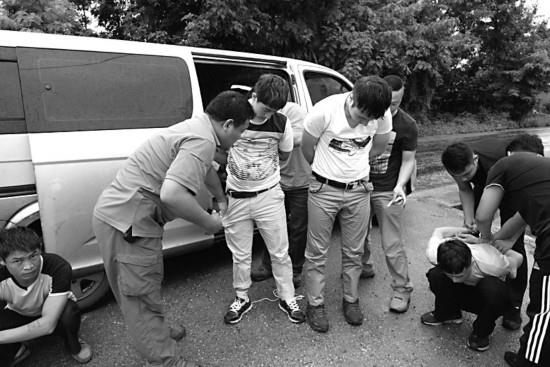
Somewhere on the border between China and Myanmar, at night, a group of more than ten people approached the border in the dark, and there were women and children inside. They swam across a shoal in front of them, and they could reach Myanmar on the other side, where someone met them. When these people approached the China-Myanmar border, they were captured by China public security personnel who had already ambushed them. In recent years, this kind of domestic and foreign "snakeheads" collude with each other to organize smuggling activities, which continue to occur frequently in the southwest China-Vietnam and China-Myanmar border areas. The Global Times reporter learned from the Ministry of Public Security that most of the stowaways in the southwest border had participated in underground lectures or had been exposed to propaganda materials on terrorism. They paid tens of thousands of yuan and traveled from Xinjiang to the southwest border under the "one-stop" arrangement. The ultimate goal was to participate in the "jihad" in the Middle East. It is reported that such smuggling activities are mainly conducted behind the scenes by the overseas "East Iraqi Movement" organization, which encourages stowaways to carry out "jihad" on the spot if they are blocked from leaving the country.
People who are blocked from smuggling create a terrorist case in Kunming.
On the night of March 1, 2014, a group of thugs rushed into Kunming Railway Station with weapons, and cut everyone they saw, killing 31 innocent people and injuring 141 others. A person in charge of the Criminal Investigation Bureau of the Ministry of Public Security told the Global Times reporter that this was a typical case in which a person tempted by extreme thoughts tried to sneak out of the country and was blocked, and instead launched a "jihad" on the spot in China. "In recent years, foreign forces have used religious extreme thoughts to confuse people and incite domestic people to participate in the’ migration jihad’. If the bewitched person is blocked in the process of smuggling out of the country, he will not hesitate to launch terrorist activities on the spot, causing great harm to innocent people. "
Shortly after the terrorism case in Kunming, there was another case of stowaways assaulting a police officer at the Sino-Vietnamese border crossing in Guangxi. The two victims in the case were Vietnamese military police.
On April 18, 2014, just after noon, there was a sudden shout of killing in the joint inspection building of Beifengsheng Port in Vietnam. At that time, Vietnamese military and police personnel escorted 16 China stowaways, preparing to repatriate them. Among the 16 people, there were 10 adult men who plotted to launch a "jihad" on the spot while being repatriated. According to the division of labor, a leading man was elected as the "Emir (Chief)". He found a toilet in the border inspection building as an excuse and opened a guard. Then he approached another guard and suddenly hugged each other, shouting slogans. The rest quickly smashed the wooden chairs around them, attacked the guards with wooden bars, grabbed submachine guns and fired. Vietnam quickly mobilized a large number of military police to arrive at the scene, and eight stowaways were killed in the crossfire.
It was later found that all 16 people were from Xinjiang. During the trial, the stowaway was deeply bewitched by extreme thoughts and indifferent to his family and children, which shocked China public security personnel. One of the women, Gulizina Abdul Rexi, was eight months pregnant. A few months ago, she and her husband sold all their possessions and took the 16-year-old daughter from Hotan to Urumqi by bus. After staying for three days, she took the train to Guangzhou, stayed in a small hotel with daily rent in 40 yuan, and waited for the "snakehead" to arrange for smuggling out of the country. Abdurejsi’s husband was killed by the Vietnamese police in the "4 18" case. She and her daughter did not shed a tear when they learned of his death.
In the case, Ayisha Mu Abdullah, the mother of three children, came to Guangzhou with two children. Before going to the Sino-Vietnamese border, the "snakehead" said that there were not enough seats in the car and she could only take one child, so she left her eldest son and let the next group of strangers take him out of the country.
According to Gui Baodong, the detachment leader of the Criminal Investigation Detachment of Fangchenggang Public Security Bureau in Guangxi, who was involved in handling the case, Vietnamese police finally surrounded a smuggling man and persuaded him to surrender, but the latter committed suicide by jumping off a building. Such crazy resisting arrest behavior is different from ordinary people.
Extra-large cross-border smuggling network surfaced
The background of two consecutive vicious incidents in March and April last year is that organized smuggling activities in the southwest border areas of China have increased in recent years, especially the collusion between "snakeheads" at home and abroad. In April last year, the Ministry of Public Security set up a "4 29" task force. Since May, police in Henan, Guangdong, Guangxi, Sichuan, Yunnan, Xinjiang and other places have jointly cracked down on illegal immigration activities in the southwest border, and several working groups have been stationed in the front line. As a result, a complex and tight smuggling network surfaced.
This "one-stop" interest chain includes overseas command, domestic organization, transit, border guide and overseas "snakeheads". The Global Times reporter learned that among the more than 30 transnational smuggling criminal gangs destroyed by the "4 29" project, only the mega-gang headed by Guangxi "snakehead" Wei Hai organized more than 300 people to sneak out of the country from January to April 2014.
After Wei Hai was arrested, he confessed that every time he sneaked into the country, Eric Ahmad (nicknamed "A Le"), a foreigner, would give him instructions to pick him up. Wei Hai sent "Ma Zi" to hire a black car to pick up a group of stowaways, went near the border line, waited for an opportunity to cross the border at night and handed it over to the Vietnamese "snakehead". Vietnamese "snakeheads" hired cars to transport stowaways from the border to Hanoi, and then "A Le" organized stowaways to leave Vietnam.
Liu Huaming, deputy detachment leader of the Criminal Investigation Detachment of Fangchenggang Public Security Bureau in Guangxi, said that A Le paid Wei Hai 2,000 yuan for each stowaway who left the country. For stowaways, this 2000 yuan is only a short passage from the mainland to the border. Liu Huaming said, from leaving home to the border areas and then to overseas destinations, stowaways pay 30,000-50,000 yuan per capita. "The crackdown on public security in China has intensified, and the cost of smuggling has also risen. Recently, it has risen to 80,000-100,000 yuan per capita."
In response to China’s intensive crackdown, the "snakeheads" have racked their brains. The relevant person in charge of the Criminal Investigation Bureau of the Ministry of Public Security told the Global Times reporter that among a group of stowaways, "snakeheads" often have to arrange several leaders, and the jargon is called "patients". The so-called "patient" is a person who has a criminal record in China or is chased by the public security organs online. Once the smuggling process is blocked, he will lead others to "jihad" on the spot.
On August 30, 2014, the Fangchenggang police in Guangxi stopped a CMB near the Sino-Vietnamese border and asked the people on board to get off for questioning. The third middle-aged man suddenly took out a sharp knife from his waist and stabbed the nearest special police officer. Another special police officer decisively shot and wounded him. Afterwards, it was found out that the stowaway’s name was Aimeti Jiang Turgon, a native of Kashgar, Xinjiang. At the moment when the police stopped the car, he was responsible for inciting the fellow passengers to "jihad" on the spot. "We have more than a dozen special police officers and policemen present, armed with submachine guns and short guns. In this case, he still attacked with a knife, which shows that he has completely lost his mind," Liu Huaming said.
Police officer Alimu told reporters that in order to avoid inspection and crackdown, stowaways carefully designed and disguised. "Almost all the stowaways in each group are women and children, and this combination is easily mistaken for business or tourism. When they sneak out of Guangxi, they generally don’t go directly from Xinjiang to the border of Guangxi, but bypass other provinces and cities, and then hire’ black cars’ to get close to the border. "
Religious extreme thought is the root.
Since the "4 29" project was launched for more than eight months, the high incidence of illegal immigration has been curbed. The reporter of Global Times was informed that the public security frontier departments in Guangxi and Yunnan seized 166 illegal immigrants from January to April last year. After the operation, 34 people were seized from May to June, and only one person was seized by the Yunnan frontier department in July.
A domestic security official told the Global Times reporter on the 18th that the causes of organized smuggling in southwest border areas are complicated, and various factors at home and abroad are intertwined. The overseas "East Iraqi Movement" organization is behind the smuggling activities, and religious extreme thoughts are the root cause of the smuggling activities, with the aim of inciting domestic ethnic minorities to leave the country to engage in "jihad" activities in Middle East and Syria. Under the influence of comprehensive factors such as the manipulation and command of the "East Iraqi Movement" abroad and the propaganda and incitement of religious extreme thoughts, some religious extremists seek to leave the country to participate in terrorist organizations and "jihad", and some people are deceived and threatened.
The behind-the-scenes role of foreign forces was exposed in the smuggling case on the southwest border. According to police officer Alimu, three Chinese who tried to cross the mountain and cross the border were arrested recently. They started from a border county in Guangxi, but they got lost and turned back and were captured by the police. "The mobile phone communication of one of them showed that the stowaway kept taking photos with his mobile phone while climbing the mountain, and passed them on to overseas organizers. The organizers marked the specific smuggling route in Uighur on the returned photos, and marked the location of border checkpoints, police stations and boundary pillars, guiding the stowaway to leave the country illegally." Alimu said that these three people actually crossed the boundary pillar, but they mistakenly thought that they were still in China and had no choice but to return to Guangxi county. "Afterwards, they confessed that the organizer was in Turkey."
The police found from the cracked smuggling cases in the southwest border that most of the people involved had participated in underground lectures or watched violent videos. These audio and video videos of terror are basically wrapped in religious cloaks, and are "packaged" by Islamic hadith and sacred religious chanting. The content is completely opposite to the "doing good and stopping evil" advocated by Islam, openly clamoring for killing and suicide, and spreading the fallacy of "jihad martyrdom into heaven". It is precisely under the brainwashing and bewitching of the extreme religious thought of "jihad and martyrdom into heaven" that these stowaways lose their rationality and do whatever it takes to get into heaven, and regard the death of themselves and others as their passport to get into heaven.
Sun Xiaoying, a researcher at Guangxi Academy of Social Sciences, said that stowaways bewitched by religious extreme thoughts must pass through many countries to reach their destinations, and they may be investigated and punished in any place and repatriated according to international law. Some people eventually become international refugees because they throw away their identity documents. The above-mentioned domestic security officials said that from the current situation, some people who have sneaked out of the country from the southwest border have gone to the Middle East to participate in the "jihad" through some countries in Southeast Asia.
The head of the Criminal Investigation Bureau of the Ministry of Public Security told the Global Times reporter that at present, the "4 29" task force has identified a group of behind-the-scenes organizers hiding abroad and the "snakeheads" of Southeast Asian countries, and issued a red wanted order to key criminal suspects through Interpol. "The next step is to strengthen cooperation with the police in Southeast Asian countries, rely on bilateral and multilateral cooperation mechanisms, jointly carry out transnational arrest work, and resolutely arrest the leaders and backbones of smuggling criminal gangs." (Liu Chang)