[Civil Servant Satisfied by the People] Kuran Ashinbeck: Intimate with the people.

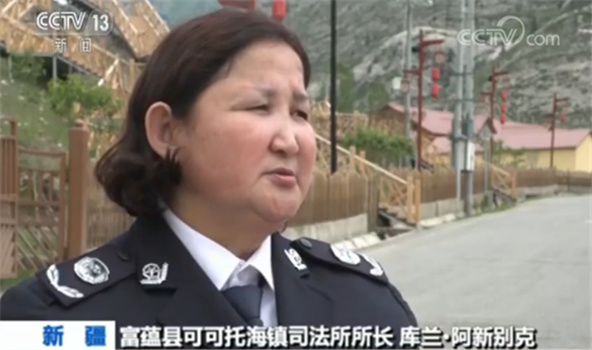
  Cctv newsIn the face of various difficulties such as demolition, judicial disputes and difficulties in people’s lives, as the director of the Judicial Office of Keketuohai Town, Fuyun County, Xinjiang, Kuran Ashinbeck has never evaded. She chose to face the problem directly and help sincerely, and solved many contradictions with her true feelings and justice, and was called the most intimate civil servant by the local people. Recently, Kuran Ashinbek was awarded as the civil servant who was satisfied by the ninth national people.

  At the beginning of June, Keketuohai Scenic Spot in Fuyun County, Xinjiang began to enter the tourist season, but this is also the last stage of the relocation of residents living in the scenic spot. Of the 60 households, 50 have moved to the new village planned and built by the government, and the last 10 households have ideological concerns. What about the land? What about the livestock? What about businesses that are making money? How to solve the traditional ideological problems of the masses, let them improve their living conditions, catch the tourist express train and realize continuous income increase? As a government civil servant, Kuran Ashinbeck had to go to work from door to door.

  When they move to their new homes, the local government will build new houses that are not smaller than their current houses, and at the same time, they will focus on building livestock sheds, and their land will be rented by tourism companies. Through patient and meticulous ideological work again and again, Kuran reassured these people.

  Kuran Ashinbeck’s job is the director of the Judicial Office of Keketuohai Town, Fuyun County. Over the past 26 years, she has worked wholeheartedly for the people and impartially enforced the law. The mediation rate of all kinds of contradictions and disputes has reached 100%, and the average success rate of mediation has reached over 98%, making her a real "caring person" for the people. Grass-roots judicial work is not just about resolving disputes. Due to the shortage of staff, Kulan has also undertaken a number of tasks such as civil affairs in the town since 2006, and the warmth and coldness of poor people have made Kulan feel worried.

Kulan Axinbeck, Director of the Judicial Office of Keketuohai Town, Fuyun County

Kulan Axinbeck, Director of the Judicial Office of Keketuohai Town, Fuyun County

  Kulan Axinbeck, Director of the Judicial Office of Keketuohai Town, Fuyun County: There is a lot to worry about when doing judicial work. Probably in 2011, when I saw the mentally handicapped children in Hardy’s family during my home visit, I decided to help him.

  Kulan actively contacted the hospital to let the children of the elderly be hospitalized, and also applied for subsistence allowances and serious illness assistance for them to solve their financial burden. For many years, Kulan visited the home several times a year to learn about Hardy’s family, and also bought some nutrients for the elderly from his own pocket.

  Cocoto Sea is located in the coldest area on the border of the motherland, and the conditions are difficult. As a grass-roots civil servant, Kuran Ashinbeck has always adhered to the initial intention of serving the people.

  Kulan Axinbeck, Director of the Judicial Office of Keketuohai Town, Fuyun CountyI was born in Cocoto Sea since I was a child, and I have never left here, which has filled me with feelings and served the people here. It has always been my wish.

Collect quickly! Blockchain is difficult to understand? Look here!

  Li Huohua and Shen Qihong

  Recently, a news has become the focus of attention. the Political Bureau of the Communist Party of China (CPC) Central Committee has made a collective study on the development status and trend of blockchain technology, emphasizing that blockchain should be regarded as an important breakthrough for independent innovation of core technology and accelerate the development of blockchain technology and industrial innovation.

  So what is blockchain technology? What is its development process and current situation? What application scenarios are there in the future? Let’s talk about it here.

  The Origin and Development of Blockchain Technology

  When it comes to blockchain, many people may think of Bitcoin. In fact, the two are not the same thing. Blockchain is the underlying technology of Bitcoin.

  In 2008, a self-proclaimed "Satoshi Nakamoto" published a white paper, hoping to build an electronic money system that won’t be spammed. In January 2009, Bitcoin was officially born, with a total limit of 21 million pieces. The distribution rules are transparent, and there is no central issuer, which is automatically executed by code. The code and operation of Bitcoin are maintained by the participants, and anyone in the world can participate in it.

  At first, Bitcoin was only circulated among computer geeks. Some people tried it as a new gadget, while others were attracted by its utopian ideal of not spamming and circulating freely. In 2010, there was even a story that a programmer exchanged 10,000 bitcoins for two pizzas. In any case, few people would have thought that bitcoin would have such a great influence later.

  With the passage of time, bitcoin gradually spread from the computer geek circle. As more and more people participate, capital speculation and speculation follow one after another, and the price of Bitcoin has also started the skyrocketing and plunging mode, which has attracted the attention and reports of some mainstream media and attracted more and more people to study Bitcoin.

  After studying the code of Bitcoin, people collectively refer to the underlying technology adopted by Bitcoin as blockchain technology, and Bitcoin is the first application of blockchain technology. If bitcoin is compared to bread, then the blockchain is flour. Flour can be made into bread, noodles, rolls, steamed bread and cakes. Similarly, you can use blockchain technology to create bitcoin, and you can also use blockchain technology to do many other things to benefit the whole society.

  Blockchain is a "trusted machine"

  As the name implies, blockchain is a combination of "block" and "chain", which is essentially a distributed account book. So, how does this account book keep accounts and how does it work? We might as well use an analogy to illustrate.

  At the beginning, a group of people first stood up and took a blank piece of paper for bookkeeping, and the system gave this bookkeeper a certain amount of reward (such as 50 bitcoins). After recording the bill, generate an anti-counterfeiting code from this page of bill through encryption algorithm, and copy the bill to all other people at the same time. Next, by calculating a difficult problem, the person who works out first can keep accounts and enjoy the rewards given to the bookkeeper by the system. When recording the bill on the second page, you need to write the anti-counterfeiting code of the bill on the first page at the beginning, and then make an account. After recording, you can also generate an anti-counterfeiting code of the bill on the second page through encryption algorithm, and then copy the bill to everyone else. Then, everyone will compete for the right to charge the bill on the third page by calculating the next difficult problem. This bill will also be marked with the security code of the bill on the first page, and after recording, it will also generate an security code and synchronize the bill to others, and so on. This page-by-page bill is turned into an increasingly thick general ledger through the binding line in sequence, and each participant has one copy.

  In the above analogy, the bill page by page is called a "block" and the binding line is a "chain". By binding the bill page by page in sequence into a general ledger, a "blockchain" is formed, and its essence is still an account book. Only this account book has one person, and there is no central person or organization. Everyone is equal, and everyone can compete for the right to keep accounts by calculating difficult problems. The whole account book is jointly maintained by all participants.

  Since there is no central person or organization, how can this jointly maintained account book prevent malicious people from making false accounts or tampering with account book records? Suppose Zhang San grabbed the right to charge the bill on page 100. His good friend Li Si had only 3,000 yuan in his account, but Zhang San helped him secretly change it to 30,000 yuan. After recording the account, he synchronized the account book to others. At this time, others will immediately find that there is something wrong with this account, because there is one account book, and the ins and outs of Li Si’s assets are recorded in the previous account book. Therefore, others will refuse to add the bill on page 100 with wrong records to the general ledger, and will choose another honest person to record the bill on page 100 through calculation problems.

  Therefore, we can see that blockchain technology has these characteristics: openness and transparency (everyone has one account book, everyone can check it), decentralization (there is no central person or organization), and it cannot be tampered with (because any tampering or false accounting will be discovered).

  In daily life, many people are used to paying with WeChat and Alipay, and WeChat and Alipay act as bookkeepers. We need to trust this bookkeeper not to misremember or falsify accounts. Blockchain is different. Hackers may attack and modify the account books in a computer, but if they want to really modify the blockchain data, they need to attack more than half of the account books in computers, which is very difficult, especially in a blockchain like Bitcoin. There are tens of thousands of accounting nodes, and one account book is distributed all over the world. Therefore, blockchain technology also has great advantages in security.

  Openness, transparency, decentralization and non-tampering … … Because of these advantages, the famous British financial magazine The Economist praised the blockchain as a "machine of trust".

  Blockchain empowers future social development.

  For more than a decade, blockchain technology has gone from the 1.0 era to the 2.0 era, and now it is moving towards the 3.0 era.

  In the 1.0 era of blockchain, Bitcoin is a typical representative, mainly recording transaction information simply, with very single function and limited application scenarios. In the 2.0 era of blockchain, the Ethereum project is a typical representative. Different from bitcoin with single function, Ethereum has added the function of "smart contract", which can be simply understood as a program that can be automatically executed. Because of this automatic program, the blockchain has been upgraded from a single-function account book to a world computer, on which people can develop various blockchain applications.

  As for the 3.0 era of blockchain, just like the 5G era, only after it really comes can people know what it looks like and what new business models and social impacts it will have. The blockchain we are talking about now empowers social development, mainly based on blockchain 2.0.

  So, in what ways will the blockchain empower social development?

  The first is the financial industry. The financial industry has to deal with all kinds of accounts every day. The blockchain is essentially a distributed ledger. Using the blockchain as a "trusted machine", it has obvious advantages to use blockchain technology to realize the work that needs multi-party information synchronization, such as bookkeeping, accounting, reimbursement, settlement and tax return. On August 10th last year, Shenzhen Taxation Bureau and Tencent Company launched the blockchain electronic invoice, which realized that the electronic invoice can’t be forged, the data can be inquired, the transaction can be invoiced, and the invoice can be reimbursed, which greatly simplified the traditional financial and taxation workflow.

  In addition, cross-border payment is also a major application of blockchain in the financial field. Using the advantages of blockchain technology, such as openness, transparency, non-tampering, and distrust of intermediaries, various cumbersome procedures between different banks can be reduced and the process can be accelerated in cross-border payment. On June 25th last year, Alipay launched the cross-border remittance service of e-wallet based on blockchain in Hong Kong. With the Hong Kong version of Alipay, cross-border remittance can be made to Philippine wallet Gcash through blockchain technology. At the press conference, the whole remittance process took only 3 seconds, while it took several days through the traditional cross-border transfer method.

  In addition to the financial sector, blockchain technology is also promising in business. JD.COM launched the JD.COM Zhizhen Chain a long time ago, using blockchain technology to build an anti-counterfeiting traceability platform, recording the important data of every link of goods from raw material procurement to after-sales, and jointly cracking down on counterfeiting with regulatory authorities, third-party institutions and brands. Last year’s Double Eleven, Tmall International Mall had more than 150 million cross-border goods, which made use of the traceability and non-tampering characteristics of blockchain technology to achieve permanent traceability, prevent false information and protect consumers’ rights and interests.

  In the field of people’s livelihood, the application prospect of blockchain technology is also very broad. For example, charity can use the openness and transparency of blockchain technology to monitor the flow of each charity fund and ensure that the money finally reaches the recipients.

  Blockchain technology can also simplify government affairs and realize the interconnection of various functional departments. On November 13th last year, Loudi City, Hunan Province issued the first real estate blockchain electronic certificate, which realized the interconnection between real estate registration and the data of government functional departments such as land, taxation and real estate.

  Storing data on the blockchain also has legal effect. On June 29 last year, the first case of blockchain deposit in China was pronounced in the first instance of Hangzhou Internet Court, which confirmed the legal effect of using blockchain technology to deposit electronic data and clarified the review and judgment methods of blockchain electronic deposit.

  For many people who pay attention to privacy protection, blockchain technology is a great boon. All kinds of usage data we leave on the Internet every day, including sensitive information such as identity, mobile phone number, hobbies, shopping records, location, etc., may be leaked directly or indirectly, which will bring great threats and troubles to our lives. Blockchain technology combines cryptography and encryption technology, which can realize the separation of user identity and data, encrypted storage and distributed storage, and make your own data completely in your own hands.

  The current blockchain technology is still in the early stage of development, just like the Internet around 2000. Although it is full of various possibilities, it is not mature, and there are very few successful large-scale applications, and it is also full of capital speculation and speculation. For this emerging technology, we can’t overestimate its short-term impact, nor can we ignore its long-term changes.

  (Zhan Rongrong, Lu Bufan, Ma Dan and Wu Jie also contributed to this article. Special "Vernacular Blockchain" contributed by WeChat official account)

Ministry of Transport: Do a good job in traffic control and transportation security in key areas of Henan Province to deal with the epidemic situation.

  According to the WeChat official account news of WeChat of the Ministry of Transport, recently, the special class of traffic control and transportation support of the comprehensive group of joint prevention and control mechanism in the State Council issued the Notice on Doing a Good Job in Traffic Control and Transportation Support in Key Areas of Henan Province to strictly prevent the spread of the epidemic through transportation links, and make every effort to do a good job in traffic control and transportation support in key areas of Henan Province. The full text is as follows:

  Notice of the State Council Joint Prevention and Control Mechanism Comprehensive Group Traffic Control and Transportation Support Special Class on Doing a Good Job in Traffic Control and Transportation Support for COVID-19 Epidemic in Key Areas of Henan Province

  In order to thoroughly implement the deployment of the joint prevention and control mechanism in the State Council, while strictly preventing the spread of the epidemic through transportation links, we will do our best to do a good job in traffic control and transportation security in key areas of Henan Province to deal with the epidemic. The relevant matters are hereby notified as follows:

  Scientifically and accurately implement traffic control

  Decisively cut off foreign passenger service

  The transportation authorities in Henan Province should guide the transportation authorities at the city and county level where the medium and high risk areas are located to suspend the cross-city business of buses, taxis (including online car-sharing) and hitchhiking in time; Suspend the road passenger service in and out of the district (county) where the medium and high risk is located, strictly implement the "point-to-point" transportation for the passenger lines and passenger chartered cars passing through the above areas, and may not stay and get off passengers in the above areas; It is necessary to announce the suspension to the public in a timely manner, do a good job in publicity and explanation, and do a good job in free refund service for relevant passengers (personal accident insurance, which is purchased at the same time). In areas not affected by the epidemic, in principle, road passenger service shall not be suspended. If it is really necessary to suspend, it shall be reported to the local joint defense and joint control mechanism for approval.

  Strengthen the management of urban passenger transport epidemic prevention

  The competent transportation department of Henan Province should guide the municipal and county-level transportation departments where the medium and high risks are located to adjust the urban public transportation organization plan in a targeted manner to prevent passenger flow from gathering; For urban public buses, trams and rail transit lines passing through medium and high risk areas, station-throwing transportation shall be implemented. If the districts, cities or county-level administrative regions in the middle and high-risk areas adopt closed management measures for the whole community (village) and units, it is necessary to suspend regular urban passenger transport services in time; After the epidemic situation is effectively controlled and reported to the local joint prevention and control mechanism for approval, the urban passenger transport service will be resumed in an orderly manner.

  Standardize the setting of epidemic inspection sites

  Henan Province and Hebei, Shanxi, Anhui, Shandong, Hubei, Shaanxi and other neighboring provinces traffic control and transportation security special classes (hereinafter referred to as traffic special classes) should scientifically and reasonably set up highway epidemic prevention and control inspection stations on expressways and ordinary national and provincial highways entering and leaving closed areas under the overall arrangement of the local joint prevention and control mechanism. In principle, only one inspection station is set in the same direction. It is strictly forbidden to set up epidemic prevention and control inspection stations on the main lines of expressways and provincial boundaries without authorization, and it is not allowed to block or isolate expressways, national and provincial trunk lines without authorization. It is necessary to strengthen the coordination of departments to ensure the rapid and convenient passage of transport vehicles for various key materials (hereinafter referred to as emergency materials) such as medical prevention and control materials, fresh agricultural products, key production and living materials, energy materials and postal express delivery. It is necessary to optimize the detection method, improve the detection efficiency, strengthen traffic guidance, and shorten the waiting time of vehicles. For vehicles and personnel who meet the traffic conditions, the inspection station shall not arbitrarily restrict traffic.

  Ensure the smooth traffic of vehicles at the epidemic inspection site.

  Special traffic classes in Henan Province should report to the provincial joint prevention and control mechanism for announcement, so as to guide the public not to enter and leave the cities where the epidemic-related areas are located unnecessarily. Under the deployment of the local joint prevention and control mechanism, special traffic classes in relevant areas in Henan Province should do a good job in tracking and monitoring the traffic volume, optimize the workflow of highway epidemic prevention and control inspection stations, and increase personnel, equipment and passages in time to improve inspection efficiency and reduce inspection waiting time when the traffic volume is large. Traffic classes in the surrounding provinces of Henan Province should request the local joint prevention and control mechanism to issue an announcement, and do a good job of publicity and guidance in time. Except for emergency materials transportation vehicles, other vehicles do not have to go to the cities where the epidemic-related areas in Henan Province are located, and do a good job of remote diversion and bypass at the same time to avoid traffic congestion.

  Ensure smooth and efficient transportation of emergency materials.

  Implement the vehicle pass system for emergency materials transportation.

  The special traffic class in Henan Province shall, jointly with the departments of development and reform, industry and information technology, commerce, agriculture and rural areas, establish and improve the management system of emergency materials transport vehicle pass, and announce to the public the handling conditions and procedures for the Vehicle Pass for Emergency Materials Transport for Epidemic Prevention and Control in Henan Province (hereinafter referred to as the Pass). For emergency materials transport vehicles entering and leaving the high-risk areas in Henan Province, it is necessary to apply for a Pass according to procedures; It is necessary to rely on the expressway service area, the "driver’s home" and other places to facilitate the handling of the "Pass" for emergency materials transport vehicles entering and leaving the high-risk areas in Henan.

  Do a good job in ensuring the passage of emergency materials transportation vehicles

  Local traffic classes should implement classified traffic control under the arrangement and deployment of the local joint defense and joint control mechanism, and should not be overweight or "across the board" without authorization. For emergency materials transport vehicles from cities where high-risk areas are located in Henan Province, local highway epidemic prevention and control inspection stations ensure smooth traffic on the basis that the temperature of drivers and passengers is normal, the nucleic acid test results are negative within 48 hours, the health code and travel code are green, and the Pass is held. Drivers and passengers should strictly do personal protection and health monitoring to reduce contact with other personnel; For vehicles that are confirmed to be from the city where Henan Province is located in a non-medium-high-risk area by checking the trip code, they shall not be restricted at will when the temperature of drivers and passengers is normal and the health code and trip code are green. It is necessary to set up mobile nucleic acid detection points based on expressway service areas, "drivers’ homes" and other places to provide convenience for truck drivers and other emergency materials transportation support personnel to carry out nucleic acid detection.

  Study and set up emergency materials transfer and dispatching station.

  In accordance with the unified deployment of the local joint prevention and control mechanism, the Henan Provincial Traffic Special Class should actively cooperate with relevant departments to strictly implement the epidemic prevention and control requirements, rely on existing logistics parks and freight stations to study and set up emergency materials transfer and transportation stations, set up temporary connection points in qualified high-speed service areas, formulate various plans for dispatching and operation, traffic organization, health and epidemic prevention, personnel training, improve various facilities and equipment such as loading and unloading facilities and connecting vehicles, and start to put into operation in time in combination with the actual situation, and announce to the public. For the key energy-using units in the epidemic-related areas, it is necessary to ensure the orderly transfer of energy and materials by means of throwing and hanging transportation and connecting transportation.

  Do a good job in ensuring the travel of key personnel

  Quickly set up an emergency transportation team for key personnel.

  The competent transportation department of Henan Province should guide the transportation departments at the city and county levels to make good preparations for emergency transportation convoys, organize transportation enterprises with high standard of daily management, select vehicles with good technical conditions and drivers with strong professional quality, set up emergency transportation convoys including buses, buses and taxis in different regions, and provide sufficient epidemic prevention materials to meet the travel needs of medical staff, urban basic operation support personnel and epidemic prevention workers, and ensure the public’s emergency travel needs such as medical treatment.

  Accurate formulation of emergency transportation guarantee scheme for key personnel

  The transportation authorities in Henan Province should guide the municipal and county transportation departments to establish a communication and coordination mechanism with local health and municipal departments, make full use of technical means such as online platforms and WeChat applets, accurately identify the travel needs of key people such as medical staff and urban operation support personnel, and scientifically formulate a "point-to-point" emergency transportation service guarantee scheme for key personnel and a social emergency travel guarantee scheme. The transportation departments in areas where urban passenger service is suspended should promote the establishment of a "point-to-point" contact and docking mechanism between emergency transport convoys and streets, communities, hospitals, etc., implement 7×24-hour duty, and provide quick response, safe and efficient service guarantee for people’s emergency medical trips according to the needs of relevant departments and units. It is necessary to formulate detailed plans for the prevention and control of the epidemic situation of vehicles and personnel supported by emergency transportation services, and urge enterprises that carry out emergency transportation support tasks to strictly implement epidemic prevention measures such as disinfection and ventilation, transportation organization and personnel protection.

  Effectively strengthen the prevention and control of epidemic situation in road transport industry

  Strict implementation of epidemic prevention and control requirements

  Local traffic special classes should guide freight enterprises, logistics parks, freight stations and other business units, and urge drivers and passengers, freight station management personnel, loading and unloading management personnel, cleaning staff, etc. to strictly implement epidemic prevention and control measures such as wearing masks, disinfecting and washing hands, and sterilizing transport equipment, increase the frequency of nucleic acid detection, and do a good job in personal protection and health monitoring; It is necessary to strengthen supervision and inspection, and urge the relevant passenger transport operators to implement epidemic prevention and control measures such as disinfection and ventilation, temperature measurement and code inspection, wearing masks, personal protection, passenger information registration, epidemic prevention publicity, etc. in order to prevent the epidemic from spreading through transportation.

  Strict personal protection measures for key groups

  Local transportation authorities should urge road passenger and freight transport, urban public transport, taxi and rail transit employees to strictly implement the relevant requirements for epidemic prevention and control, and earnestly do their own protection. When road passenger transport and urban public transport vehicles carry out the task of dense and sub-dense personnel transfer, and taxis undertake the task of nucleic acid sampling and transfer, the driving area and passenger area of vehicles should be physically isolated, and the drivers and passengers should be equipped with protective clothing, gloves, working caps, medical protective masks, protective screens or goggles, and a full set of protective articles should be replaced in time after transfer, and the vehicles should be strictly disinfected. Road freight drivers should do a good job of personal protection, minimize the stay time and avoid cross-operation when loading and unloading transshipment goods at emergency materials transfer and transportation stations and highway service area connection points. Local transportation authorities should draw the local joint prevention and control mechanism to fully guarantee the input of personnel protective equipment and disinfection materials needed for emergency transportation, strengthen the training of epidemic prevention and control operations for front-line road transport employees, and effectively reduce the risk of infection.

  Do a good job in ensuring the service of stranded freight vehicles in epidemic-related areas

  Traffic special classes at all levels in epidemic-related areas should, in accordance with the deployment of the local joint prevention and control mechanism, work with health and civil affairs departments to guide the service guarantee of stranded vehicle personnel in highway service areas, logistics parks and freight stations in epidemic-related areas, and provide nucleic acid detection, catering, rest and other service guarantees for stranded personnel; For truck drivers and other personnel who are allowed to leave the epidemic-related areas by the local joint prevention and control mechanism, they should be instructed to strictly carry out personal protection and health monitoring, reduce stopovers and avoid contact with other personnel. According to the deployment of the local joint prevention and control mechanism, the personnel information should be copied to the regional joint investigation and control special class for epidemic prevention and control in relevant areas in time, and included in the management scope of key personnel for epidemic prevention and control.

  Strengthen 24-hour duty.

  The traffic special class office of the comprehensive group of joint prevention and control mechanism in the State Council is on duty 24 hours a day. If there is any need to coordinate the emergency transportation in Henan Province, it can be reported to the traffic special class office of the comprehensive group of joint prevention and control mechanism in the State Council at the first time. Emergency transportation support telephone: 010-65292831.

  Traffic special classes in Henan Province, Hebei, Shanxi, Anhui, Shandong, Hubei, Shaanxi Province, etc. should be on duty 24 hours a day, announce the emergency transportation guarantee telephone number to the public in time, and coordinate and solve the traffic and transportation guarantee problems in time. Henan province emergency transportation guarantee telephone number: 15838821933.

  Epidemic prevention and control in and out of Henan Province

  Emergency materials transport vehicle pass

  (style)

frontage

back

Notice of the Ministry of Finance and the Ministry of Human Resources and Social Security on Printing and Distributing the Measures for the Administration of Employment Subsidies; Measures for the Adm

Ministry of Finance, Ministry of Human Resources and Social Security on Printing and Distributing

Notice of the measures for the administration of employment subsidy funds

Caishe [2017] No.164    

All provinces, autonomous regions, municipalities directly under the central government, the finance department (bureau), the human resources and social security department (bureau), the Finance Bureau of Xinjiang Production and Construction Corps, and the Human Resources and Social Security Bureau:

In order to give full play to the role of employment subsidy funds, effectively implement various employment and entrepreneurship support policies, and improve the safety, standardization and effectiveness of the use of funds, according to the Budget Law of the People’s Republic of China, the Employment Promotion Law of People’s Republic of China (PRC) and other relevant laws and regulations, we have formulated the Measures for the Administration of Employment Subsidy Funds. It is hereby issued, please follow it.

Finance and administration department          

Ministry of Human Resources and Social Security          

October 13, 2017      

Measures for the administration of employment subsidy funds

Chapter I General Principles

the first In order to implement various employment policies, standardize the management of employment subsidy funds and improve the efficiency in the use of funds, these Measures are formulated in accordance with the Budget Law of the People’s Republic of China, the Employment Promotion Law of People’s Republic of China (PRC) and other relevant laws and regulations.

the second The term "employment subsidy fund" as mentioned in these Measures is set up by the people’s government at or above the county level, managed by the financial department at the same level in conjunction with the human resources and social security department (hereinafter referred to as the human resources and social security department), and arranged by the general public budget for special funds to promote employment and entrepreneurship.

Article The management of employment subsidy funds should follow the following principles:

(1) Pay attention to Pratt & Whitney and give priority to it. We will implement the national inclusive employment and entrepreneurship policy, focus on supporting the employment and entrepreneurship of groups with employment difficulties, moderately tilt to the central and western regions and areas with heavy employment tasks, promote the fair employment of all types of workers, and promote the coordinated development of employment among regions.

(two) the combination of awards and compensation, incentive compatibility. Optimize the mechanism design, combine rewards with compensation, and give full play to the enthusiasm of policy enforcement departments and policy targets at all levels.

(3) Easy operation and accurate performance. Improve the operability and accuracy of policies, strengthen supervision and control, and strengthen the management of employment subsidy funds with performance orientation and result orientation.

Chapter II Scope of Capital Expenditure

Article 4 Employment subsidy funds are divided into two categories: subsidies for individuals and units, and subsidies for public employment service capacity building.

Subsidies for individuals and units are used for expenses such as vocational training subsidies, vocational skill appraisal subsidies, social insurance subsidies, public welfare post subsidies, entrepreneurship subsidies, employment trainee subsidies, job-seeking and entrepreneurship subsidies; Public employment service capacity building subsidy funds are used for employment and entrepreneurship service subsidies and high-skilled personnel training subsidies and other expenses.

If the subsidy of employment subsidy funds for the same project is duplicated in unemployment insurance benefits, individuals and units cannot enjoy it repeatedly.

Article 5 The range of people who enjoy vocational training subsidies includes: children from poor families, college graduates in graduation year (including senior technician classes, preparatory technician classes and vocational education graduates from special education colleges, the same below), fresh junior and senior high school graduates who have not continued their studies in urban and rural areas, rural migrant workers, registered unemployed people in cities and towns (hereinafter referred to as five categories), and qualified enterprise employees.

Vocational training subsidies are used in the following aspects:

(a) five categories of personnel employment skills training and entrepreneurship training. For five types of personnel who have participated in employment skills training and entrepreneurship training and obtained vocational qualification certificates after training (or vocational skill grade certificates, special vocational ability certificates and training qualification certificates, the same below), certain standards of vocational training subsidies will be given. All localities should accurately meet the needs of industrial development and the needs of educated people, regularly publish the guidance catalogue of vocational training needs of key industries, and appropriately raise the subsidy standard for vocational training in the guidance catalogue. Training institutions that advance the training fees for the labor reserve system for fresh junior and senior high school graduates who have not continued their studies in urban and rural areas shall be given certain standards of vocational training subsidies. Among them, rural students and urban low-income family students participate in the labor preparation training, and at the same time give a certain standard of cost of living allowance.

(2) Job skills training for qualified enterprise employees. For five categories of personnel newly hired by enterprises, if they sign labor contracts with enterprises for more than one year, and participate in on-the-job skills training by enterprises relying on their training institutions or training institutions recognized by the government within one year from the date of signing labor contracts, they will be given certain standards of vocational training subsidies to employees or enterprises after obtaining professional qualification certificates. In accordance with the relevant provisions of the state to participate in the enterprise new apprenticeship training, technician training of enterprise employees, after training to obtain vocational qualification certificates, to give employees or enterprises a certain standard of vocational training subsidies.

(3) Project-based training for qualified personnel. Local people’s organizations and financial departments can purchase employment skills training or entrepreneurship training programs from the training institutions recognized by the government through the project system, and provide free employment skills training or entrepreneurship training for the unemployed in enterprises with excess capacity in the steel, coal, coal and electricity industries (hereinafter referred to as the unemployed who have gone to capacity) and poor laborers who have set up files. Training institutions that undertake project-based training tasks are given certain standards of vocational training subsidies.

Article 6 Five types of personnel who have passed the initial vocational skill appraisal and obtained the vocational qualification certificate (excluding the training certificate) shall be given the vocational skill appraisal subsidy. For those who are included in the guidance catalogue for the evaluation of vocational qualifications and vocational skills in key industries, the subsidy standard may be appropriately raised.

Article 7 The scope of people who enjoy social insurance subsidies includes: people with employment difficulties and college graduates who meet the provisions of the Employment Promotion Law.

Social insurance subsidies are used in the following aspects:

(a) social insurance subsidies for people with employment difficulties. Units that employ people with employment difficulties and pay social insurance premiums, and units that place people with employment difficulties through public welfare posts and pay social insurance premiums, shall be subsidized according to the basic old-age insurance premiums, basic medical insurance premiums and unemployment insurance premiums actually paid for people with employment difficulties, excluding the part that individuals with employment difficulties should pay. A certain amount of social insurance subsidies shall be given to the social insurance premiums paid by people with employment difficulties after flexible employment, and the subsidy standard shall not exceed 2/3 of their actual contributions in principle. The term of social insurance subsidies for people with employment difficulties can be extended to retirement except for those with employment difficulties who are less than 5 years away from the statutory retirement age, and the rest of the staff can not exceed 3 years at the longest (subject to the age when they first approved to enjoy social insurance subsidies).

(2) Social insurance subsidies for college graduates. Small and micro enterprises that employ college graduates in the graduation year, sign labor contracts with them for more than one year and pay social insurance premiums for them will be given social insurance subsidies for a maximum of one year, excluding the part that college graduates should pay individually. A certain amount of social insurance subsidies shall be given to the social insurance premiums paid by college graduates who have not been employed within one year after leaving school. The subsidy standard shall not exceed 2/3 of their actual contributions in principle, and the maximum subsidy period shall not exceed 2 years.

Article 8 The range of people who enjoy public welfare post subsidies is people with employment difficulties, with emphasis on older unemployed people and zero-employment family members.

Post subsidies shall be given to the people with employment difficulties who are placed in public welfare posts, and the subsidy standards shall be implemented with reference to the local minimum wage standards.

The term of public welfare post subsidy can be extended to retirement except for those with employment difficulties who are less than 5 years away from the statutory retirement age, and the rest of the staff can not exceed 3 years at the longest (subject to the age when they first approved to enjoy public welfare post subsidy).

Article 9 For the first time to establish small and micro enterprises or engage in self-employment, and the established enterprises or individual industrial and commercial households have been operating normally for more than one year since the date of industrial and commercial registration, college graduates and people with employment difficulties who have left school for two years will be given a one-time entrepreneurship subsidy on a pilot basis. The specific pilot measures shall be formulated separately by the provincial finance and human society departments.

Article 10 The range of people who enjoy the employment internship subsidy is college graduates who have not been employed within 2 years after leaving school, and those in hard and remote areas, old industrial bases and national poverty-stricken counties can be expanded to secondary vocational graduates who have not been employed within 2 years after leaving school. To absorb the above-mentioned personnel to participate in the employment internship units, give a certain standard of employment internship subsidies, for the internship units to pay the basic living expenses of the trainees during the internship, to handle the personal accident insurance for the trainees, and to guide and manage the trainees. The trainee probation period retention rate reached more than 50% of the units, can be appropriately raised trainee subsidy standards.

Article 11 For college graduates from low-income families, poor disabled families, poverty-stricken families and poor people who have the willingness to find jobs and start businesses in the graduation year, and college graduates who are disabled and have obtained national student loans, one-time job-seeking and starting businesses subsidies will be given.

Article 12 Employment and entrepreneurship service subsidies are used to strengthen the service capacity building of public employment and entrepreneurship service institutions, focusing on supporting the construction and maintenance of information network systems, public employment and entrepreneurship service institutions and their recruitment activities and entrepreneurial services with universities, giving awards to business incubators, and purchasing basic employment and entrepreneurship service achievements from the society.

Article 13 The subsidy for high-skilled personnel training is mainly used for the construction of high-skilled personnel training bases and the construction of skill master studios.

Article 14 Other expenditures refer to the project expenditures that need to be added with the approval of the provincial people’s governments and in line with the relevant management regulations of the central special transfer payment.

Article 15 The specific standards of employment subsidy funds for individuals and units shall be determined by the provincial finance and human society departments in combination with local conditions on the basis of complying with the above principles. All localities should strictly control the expenditure proportion of employment and entrepreneurship service subsidies.

Article 16 Employment subsidy funds shall not be used for the following expenses:

(1) Expenditure on the construction of office buildings.

(2) Expenditure on the construction of staff dormitory.

(3) Expenditure on purchasing vehicles.

(four) the payment of staff allowances and subsidies and other expenses.

(5) "three public" expenditures.

(six) inclusive finance business guarantee loans (original small secured loans, the same below) discount and supplement business guarantee loan fund related expenses.

(seven) the department budget has arranged expenditure.

(eight) other expenses prohibited by laws and regulations.

Individuals and units in accordance with these measures to apply for subsidies, the specific use can be determined by the applicant or the applicant, not subject to the provisions of this article.

Chapter III Allocation and Release of Funds

Article 17 The central financial employment subsidy funds shall be allocated by factor method.

Distribution factors include basic factors, input factors and performance factors. Among them:

(a) the basic factors are mainly based on the labor force population and other indicators, focusing on the assessment of employment tasks.

(two) the input factors are mainly based on the arrangement and use of local government employment subsidy funds and other indicators, focusing on the assessment of local investment.

(III) Performance factors are mainly based on indicators such as the unemployment rate and the number of new jobs in various places, focusing on assessing the effectiveness of implementing various employment policies in various places.

The factors, weights, methods and the upper and lower limits of the annual allocation of funds can be appropriately adjusted according to the overall employment situation and the focus of work tasks.

Article 18 Local governments can implement project management for the subsidy funds for the training of high-skilled talents in the public employment service capacity building subsidy funds, and local human resources and social departments should prepare medium-and long-term plans for the training of high-skilled talents and determine the key areas of high-skilled talents supported by the region.

Every year, the provincial departments of human resources and social security need to organize experts to review the high-skilled personnel training project to be implemented in conjunction with the financial department. The provincial financial department and the human resources and social security department will give a fixed subsidy according to the review results, and the review results should be reported to the Ministry of Human Resources and Social Security and the Ministry of Finance for the record.

Article 19 The Ministry of Finance and the Ministry of Human Resources and Social Security will issue the estimated number of employment subsidy funds for the next year to the provincial financial and human resources departments before October 31 each year; Every year, within 90 days after the National People’s Congress examines and approves the central budget, the central financial employment subsidy fund budget is officially issued.

Article 20 The provincial finance and human society departments should formally reach the municipal and county finance and human society departments within 30 days after receiving the employment subsidy funds from the central government; Provincial and municipal finance and human society departments shall formally allocate the employment subsidy funds allocated by the government budget at the corresponding level to the lower-level government to the lower-level finance and human society departments within 60 days after the budget is approved by the people’s congress at the corresponding level.

Local financial and social departments at all levels should put forward clear requirements for fund management of the employment subsidy funds they use, and organize and implement various employment and entrepreneurship policies in a timely manner.

Article 21 Employment subsidy funds should be in accordance with the provisions of the Ministry of Finance on the performance target management of special transfer payments, and do a good job in setting, reviewing and issuing performance targets.

Chapter IV Application and Use of Funds

Article 22 Vocational training subsidies shall be paid in advance and by credit. Conditional areas should explore the establishment of personal credit accounts for vocational training for workers, encourage workers to choose training institutions and courses independently, and pay training fees through credit accounts.

Applying for vocational training subsidy funds shall comply with the following requirements according to the specific purposes of the funds:

(1) Five categories of personnel applying for employment skills training and entrepreneurship training subsidies shall provide the following materials to the local social departments: a copy of the Employment and Entrepreneurship Certificate (or the Employment and Unemployment Registration Certificate and the Social Security Card, the same below), a copy of the vocational qualification certificate, and an administrative fee bill (or tax invoice, the same below) issued by the training institution.

(2) If a vocational training institution applies for vocational training subsidies for junior high school graduates, children from poor families and urban registered unemployed people who have not continued their studies in urban and rural areas, it shall also provide the following materials: a copy of the ID card (for urban registered unemployed people, a copy of the Employment and Entrepreneurship Certificate), a copy of the junior high school graduation certificate, and an application agreement on their behalf; Cost of living allowance application materials for students from urban low-income families should also be accompanied by proof materials of minimum living guarantee for urban residents.

(3) Eligible employees of enterprises applying for skills training subsidies shall provide the following materials to local social departments: copies of professional qualification certificates, bills of administrative fees issued by training institutions, etc. Enterprises applying for new apprenticeship training subsidies for on-the-job employees should provide the following materials: copies of vocational qualification certificates, administrative fees bills issued by training institutions, etc. Before carrying out technician training or new apprenticeship training, enterprises should also report the training plan, roster of trainers, copies of labor contracts and other relevant materials to the local community departments for the record.

(4) If a vocational training institution conducts project-based training for the unemployed who have lost capacity and the poor laborers who have set up their files, it shall provide the following materials to the human and social departments entrusted with the training when applying for subsidy funds: a copy of the ID card, a copy of the vocational qualification certificate, an administrative fee bill issued by the training institution, a training plan and outline, training contents and teaching materials, information of the lecturers, video materials of the whole course, etc. Training institutions should also report the training plan and outline, the roster of trainers and other relevant materials to the local community departments for the record before carrying out project-based training.

After the above application materials have been audited by the human resources and social departments, the training subsidies or cost of living allowance funds applied by five categories of personnel and employees in enterprises will be paid to the applicant’s personal bank account or personal credit account according to regulations; The training subsidy funds for enterprises and training institutions to apply for or directly subsidize training institutions shall be paid to the basic deposit account opened by enterprises and training institutions in the bank according to regulations.

Article 23 Five categories of personnel applying for subsidies for vocational skill appraisal should provide the following materials to the local social departments: a copy of the Employment and Entrepreneurship Certificate, a copy of the vocational qualification certificate, and an administrative fee bill (or tax invoice) issued by a vocational skill appraisal institution. After being audited by the human and social departments, the subsidy funds will be paid to the applicant’s personal bank account as required.

Article 24 Social insurance subsidies shall be paid first, and the following requirements shall be followed according to the specific use of funds:

(1) Units that employ people with employment difficulties and small and micro enterprises that employ college graduates in the graduation year should provide the following materials to the local community departments when applying for social insurance subsidies: a list of qualified personnel, a copy of the Employment and Entrepreneurship Certificate or a copy of the graduation certificate, a copy of the labor contract, a detailed account (bill) of social insurance payment issued by the social insurance fee collection agency, etc.

(2) Persons with employment difficulties who have flexible employment and college graduates who have left school within one year should provide the following materials to the local social department when applying for social insurance subsidies: a copy of the Employment and Entrepreneurship Certificate or a copy of the graduation certificate, proof materials for flexible employment, and a detailed account (form) of social insurance payment issued by the social insurance fee collection agency.

(III) Units that have placed people with employment difficulties through public welfare posts should provide the following materials to the local community departments when applying for social insurance subsidies: a copy of the Employment and Entrepreneurship Certificate, proof of the years of enjoying social insurance subsidies, and a detailed account of social insurance payment issued by the social insurance premium collection agency.

After the above-mentioned funds are audited by the human and social departments, the subsidy funds will be paid to the basic deposit account or the applicant’s personal bank account opened by the unit in the bank according to regulations.

Article 25 Units that have placed people with employment difficulties through public welfare posts should provide the following materials to the local community departments when applying for public welfare post subsidies: a copy of the Employment and Entrepreneurship Certificate, proof of the years of enjoying public welfare post subsidies, and a detailed account (single) of wages paid by the unit. After the audit by the human society department, the subsidy funds will be paid to the personal bank account of basic deposit account or the public welfare post placement personnel opened by the unit in the bank according to the regulations.

Article 26 Units that recruit unemployed college graduates who have left school for two years to participate in employment internship should provide the following materials to the local social department when applying for employment internship subsidy: list of people who participated in employment internship, employment internship agreement, copy of Employment and Entrepreneurship Certificate, copy of graduation certificate, detailed account (single) of basic living allowance issued by the unit, and copy of personal accident insurance invoice for trainees, etc. After the audit by the human and social departments, the subsidy funds will be paid to the basic deposit account opened by the unit in the bank according to the regulations.

Article 27 Eligible college graduates applying for job-seeking and entrepreneurship subsidies should provide the following materials to the local social departments: proof materials for graduates to obtain national student loans (or poor families who enjoy subsistence allowances, have disabilities, set up files and set up cards, families with poor disabled people, and provide assistance and support in extreme poverty), and copies of graduation certificates (or school registration certificates). The application materials will be paid to the graduate’s personal bank account according to the regulations after the preliminary examination of the graduate’s university is reported to the local social department for examination.

Article 28 The financial and social departments at or above the county level can support the public employment service institutions at lower levels to strengthen the construction of their human resources market information network system through the employment and entrepreneurship service subsidy funds. For the free public employment service undertaken by the grass-roots public employment service institutions and the business incubation service carried out by the business incubation base, certain subsidies should be given according to the workload, professionalism and effectiveness. Public employment and entrepreneurship service institutions and their recruitment activities and entrepreneurship services with universities should be given certain subsidies according to the number of service personnel, effectiveness and cost.

The financial and social departments at or above the county level may purchase the fruits of basic employment and entrepreneurship services from the society according to the relevant provisions of government procurement services, and the specific scope and measures shall be determined by the provincial financial and social departments.

Article 29 All localities should combine the needs of regional economic development, industrial revitalization and development planning and the development of emerging strategic industries, rely on vocational training institutions and urban public training bases with high-skilled personnel training capabilities, build high-skilled personnel training bases, and focus on activities such as high-skilled personnel training, high-skilled personnel evaluation, vocational skills competition, high-skilled personnel curriculum development, and high-skilled personnel achievement exchange.

All localities should give full play to the important role of high-skilled leading talents in skills transmission, skills research, skills inheritance and skills promotion, select outstanding high-skilled talents in the front line of industry, enterprise production and service, build a skills master studio based on their units, and carry out skills inheritance and upgrading activities such as training, research, research and communication.

The specific scope of the use of subsidy funds for the training of high-skilled personnel shall be determined by the provincial finance and human resources departments in light of the actual situation and in accordance with the existing regulations.

Article 30 Local people’s organizations and financial departments at all levels should further optimize their business processes and actively promote online declaration, online audit and online verification. For the information and materials of individuals and units that can be obtained by relying on the management information system or by information sharing and business collaboration with relevant units, the subsidy funds can be directly audited, and units and individuals are no longer required to submit paper materials.

Article 31 The payment of employment subsidy funds shall be implemented in accordance with the relevant provisions of the financial treasury management system.

Chapter V Fund Management and Supervision

Article 32 Local financial and social departments at all levels should establish and improve financial management rules and regulations, strengthen internal financial management, optimize business processes, and strengthen internal risk prevention and control.

Local people’s social departments at all levels should establish and improve the ledger of employment subsidy funds, do a good job in the basic work of employment subsidy funds use management, effectively identify the authenticity of personnel and units enjoying subsidy policies, and prevent fraud. Implement the relevant provisions of laws and regulations such as government procurement and standardize procurement behavior. Strengthen the informatization construction, timely incorporate the subsidized personnel, project subsidy units, fund standards, budget arrangement and implementation into the management information system, and realize information sharing with the financial department.

Article 33 Local financial and social departments should establish and improve a scientific and standardized performance evaluation index system, and actively promote the performance management of employment subsidy funds. The Ministry of Finance and the Ministry of Human Resources and Social Security shall regularly entrust a third party to evaluate the performance of employment subsidy funds according to the employment situation in various places. The local financial and social departments at all levels shall evaluate the performance of the use of employment subsidy funds in the local area, and take the evaluation results as an important basis for the allocation of employment subsidy funds.

Article 34 Financial departments at all levels should speed up the disbursement of funds and reduce the carry-over balance. The human and social departments should actively promote the implementation of employment and entrepreneurship support policies in accordance with the provisions of these measures to ensure the effectiveness of the use of funds.

Article 35 The financial and social departments at all levels should include the management and use of employment subsidy funds in the scope of key supervision and inspection. Where conditions permit, they can hire qualified social intermediary agencies to carry out third-party supervision and inspection, and consciously accept the inspection and social supervision of auditing departments.

Article 36 Local financial and social departments at all levels shall, in accordance with the overall requirements of financial budget and final accounts management, do a good job in the annual budget and final accounts.

Article 37 People’s organizations and financial departments at all levels shall do a good job in information disclosure, and disclose to the public the overall objectives of the annual employment work, the completion of work tasks, and the use of various subsidy funds through local media and departmental websites.

The disclosure of the use of various subsidy funds includes: the name of the unit or the list of personnel who enjoy various subsidies (including ID number), subsidy standards and specific amounts, etc. Among them, the vocational training subsidy should also disclose the training content and the training results obtained; Public welfare post subsidies should also disclose the name of public welfare posts, the establishment unit, the list of resettlement personnel, and the time to enjoy subsidies; Job-seeking and entrepreneurship subsidies should be publicized in colleges and universities in the first instance.

Article 38 The financial and social departments at all levels shall establish an accountability mechanism for the "who uses and who is responsible" employment subsidy funds.

Financial, human and social departments at all levels and their staff members who violate the provisions of these measures in the work of allocation, audit, use and management of employment subsidy funds, as well as other violations of laws and regulations such as abuse of power, dereliction of duty and corruption, shall be investigated for corresponding responsibilities in accordance with the Budget Law of the People’s Republic of China, the Civil Service Law of People’s Republic of China (PRC), the Administrative Supervision Law of the People’s Republic of China and other relevant national laws and regulations. Anyone suspected of committing a crime shall be transferred to judicial organs for handling according to law.

For areas that neglect management and use funds illegally, the central government will deduct their employment subsidy funds for the next year accordingly; If the circumstances are serious, the qualification for obtaining employment subsidy funds in the next year will be cancelled and notified nationwide.

Chapter VI Supplementary Provisions

Article 39 Provincial finance, human and social departments can formulate specific implementation measures for the management and use of employment subsidy funds in accordance with these measures according to the actual situation in various places.

Article 40 These Measures shall come into force as of the date of promulgation. The Notice of the Ministry of Finance and the Ministry of Human Resources and Social Security on Printing and Distributing the Interim Measures for the Administration of Employment Subsidies (Caishe [2015] No.290) shall be abolished at the same time.

Lifan Maple Leaf 80V Car Guide Wheelbase is 2807mm.

Whether it is a fuel vehicle or a new energy vehicle, as long as it meets the needs of consumers, it is a good car. Some netizens left a message and wanted to see it. Today it came. The following small series will tell you in detail.

Let’s look at the appearance of Lifan Maple Leaf 80V first. The shape of Lifan Maple Leaf 80V front is very concise and looks comfortable. Coupled with headlights, the overall look has a certain sense of hierarchy. The car is equipped with LED daytime running lights, headlight height adjustment, delay closing and so on. Come to the side of the car, the car body size is 4706MM*1909MM*1699MM, the car uses simple lines, the car side gives a very dynamic feeling, with large-size thick-walled tires, eye-catching shape. Looking back, the rear of the car echoes the front of the car, the taillights look cool, and the overall shape is still very attractive.

Coming to the Lifan Maple Leaf 80V car, the interior design is more dynamic and makes people feel very delicate. The steering wheel of the car is very atmospheric in shape, and it is equipped with functions such as manual steering wheel up and down+front and rear adjustment, which gives people an impulse to control it. From the central control point of view, the design of the center console is reasonable, which makes the interior design quite layered and conforms to the mainstream aesthetics. Let’s take a look at the dashboard and seats again. The car is equipped with a simple dashboard and looks strong in technology. The car uses imitation leather seats, which are wide and thick, and are basically enough for daily use.

Lifan Maple Leaf 80V motor has a total power of 100KW, a total torque of 230N.m and a maximum cruising range of 410km. The cruising range of this electric vehicle is good, and it is OK to meet daily needs.

Lifan Maple Leaf 80V trunk has a good space, and it can also expand the storage space by putting down the rear seats, which is enough for daily use. At the same time, the car is equipped with anti-lock braking system (ABS), LED daytime running lights, brake assist (EBA/BAS, etc.), braking force distribution (EBD), traction control (ASR/TCS, etc.), main driver airbag and co-pilot airbag.

This car performs well in terms of space and configuration. As for the design, everyone has everyone’s aesthetics. If you are planning to buy a car, then the car above is worth considering.