Pension investment results were released last year. What is the rate of return of 10.95%?
The trillions of pension investment transcripts that have received much attention have been released.
On September 14th, the National Social Security Fund Council issued the Annual Report on the Entrusted Operation of the Basic Endowment Insurance Fund of the National Social Security Fund Council (2020), which showed that at the end of 2020, the total assets of the basic endowment insurance fund were 1,395.085 billion yuan, and the income from the equity investment of the basic endowment insurance fund was 113.577 billion yuan, with an investment return rate of 10.95% last year, higher than the level of 9.03% in 2019.
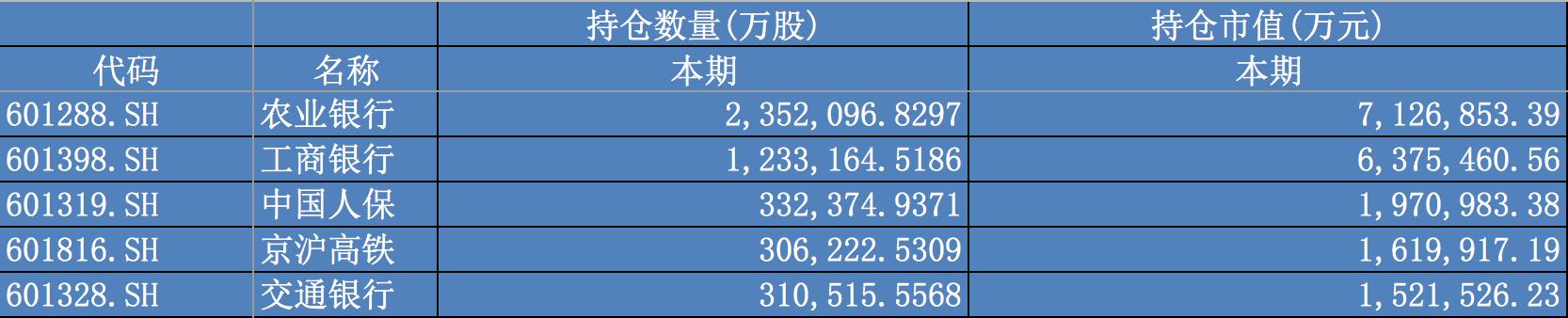
According to the semi-annual report of listed companies, the reporter counted the latest shareholding roadmap of social security fund and basic endowment insurance fund respectively. From the industry distribution of the top five heavyweight stocks, social security funds still prefer finance.
The return on investment is 10.95%
The basic old-age insurance fund is a part of the balance fund of basic old-age insurance and its investment income entrusted by the people’s governments of all provinces (autonomous regions and municipalities directly under the Central Government) according to the Measures for Investment Management of Basic Old-age Insurance Fund issued and implemented in the State Council on August 17, 2015. According to the Measures for the Administration of Investment in Basic Endowment Insurance Funds and the entrusted investment management contracts signed by the Social Security Fund and the people’s governments of the entrusted provinces (autonomous regions and municipalities directly under the Central Government), the Social Security Fund will implement separate management, centralized operation and independent accounting for the entrusted basic endowment insurance funds.
According to the data, in 2020, the income from equity investment of the basic pension insurance fund was 113.577 billion yuan, with an investment return rate of 10.95%, of which: realized income was 85.327 billion yuan (realized return rate was 8.50%), and the change in fair value of trading assets was 28.250 billion yuan. Since the basic endowment insurance fund was commissioned in December 2016, the accumulated investment income was 198.646 billion yuan, with an average annual investment return rate of 6.89%.
It is reported that the investment scope of the basic old-age insurance fund mainly includes: bank deposits, central bank bills and interbank deposit certificates; Treasury bonds, policy and development bank bonds, financial bonds with credit rating above investment grade, corporate bonds, local government bonds, convertible bonds (including convertible bonds with separate transactions), short-term financing bonds, medium-term notes, asset-backed securities, and bond repurchase; Pension products, listed securities investment funds, stocks, equity, stock index futures, treasury bonds futures. In addition, the basic old-age insurance fund can participate in the investment of major national projects and major projects through appropriate means. When key state-owned enterprises are restructured and listed, the basic endowment insurance fund can make equity investment.
The annual report pointed out that the Social Security Fund has formed a relatively complete asset allocation system including strategic asset allocation plan, annual tactical asset allocation plan and quarterly asset allocation implementation plan in its investment and operation. Among them, the strategic asset allocation plan determines the medium and long-term target allocation ratio and proportion range of various assets. The annual tactical asset allocation plan is to determine the allocation ratio of various assets in the year within the range of various asset ratios specified in the strategic asset allocation plan. The quarterly asset allocation implementation plan is to determine the specific quarterly implementation plan and make dynamic adjustments through the analysis of the situation and the examination of the annual asset allocation plan.
In terms of investment methods, the social security fund will adopt a combination of direct investment and entrusted investment to carry out investment operations. Direct investment is directly managed and operated by the Social Security Fund, mainly including bank deposits and equity investments. The entrusted investment is managed and operated by the investment manager entrusted by the Social Security Fund, mainly including domestic stocks, bonds, pension products, listed and circulated securities investment funds, stock index futures, treasury bonds futures, etc.
According to the annual report, at the end of 2020, the total assets of the basic old-age insurance fund were 1,395.085 billion yuan, the total liabilities were 150.627 billion yuan (mainly short-term liabilities formed in the investment and operation of the basic old-age insurance fund), and the total equity was 1,244.458 billion yuan, of which: the direct investment was 470.006 billion yuan, accounting for 37.77%; The entrusted investment was 774.452 billion yuan, accounting for 62.23%.
Steady investment performance
As the weather vane of long-term capital in the capital market, what is the investment performance of the basic endowment insurance fund?
On August 18th, the 2020 Annual Report of Social Security Fund was released. The National Social Security Fund is a national social security reserve fund, which is used to supplement and adjust social security expenditures such as endowment insurance during the peak period of population aging. The National Social Security Fund consists of central budget allocation, state-owned capital transfer, fund investment income and funds raised in other ways approved by the State Council.
By the end of 2020, the total assets of the social security fund were 2,922.661 billion yuan, the investment income of the social security fund was 378.660 billion yuan, and the investment return rate was 15.84%. Among them, the realized income was 204.574 billion yuan (realized rate of return was 9.58%), and the fair value change of trading assets was 174.086 billion yuan; Since the establishment of the Social Security Fund, the average annual investment return rate is 8.51%, and the accumulated investment income is 1,625.066 billion yuan.
Compared with the index performance, at the end of 2020, the Shanghai Composite Index closed at 3,473.07 points, an increase of 13.9%; Shenzhen Component Index closed at 14,470.68 points, up 4,039.91 points or 38.7% from the end of last year.
Compared with the investment income of insurance funds, some market statistics show that in 2020, the investment income of insurance funds on stocks and securities investment funds totaled 310.1 billion yuan. Among them, the rate of return of insurance investment securities investment funds is 12.2%, and the rate of return of investment stocks is 10.87%.
The data shows that the total net investment income of listed insurance companies in 2020 was 481.656 billion yuan, a year-on-year increase of 10.03%; The total investment income increased by 14.20% to 585.634 billion yuan.
List of Awkwardness Stocks Released
Recently, the semi-annual report of listed companies has been disclosed, and the latest shareholding roadmap of social security funds and basic endowment insurance funds has also surfaced.
According to the reporter’s statistics, at the end of the second quarter, the social security fund held the highest market value of Agricultural Bank of China (601288.SH), reaching 71.3 billion yuan, with 23.5 billion shares. From the industry distribution of the top five heavyweight stocks, social security funds still prefer finance.
In terms of basic endowment insurance funds, in terms of the number of shares held, Focus Media has the largest number of shares in the first half of the year, with a shareholding of 133,594,900 shares; Judging from the stock market value, the market value of Renfu Medicine’s positions reached 1,324,672,800 yuan.

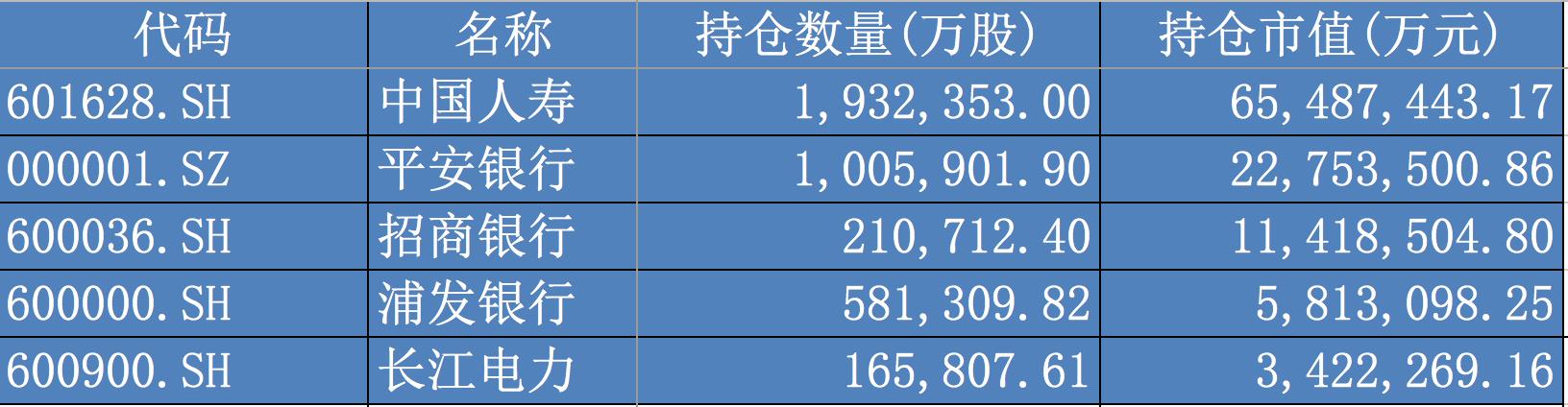
In addition, insurance funds are also one of the weathervanes of long-term funds in the capital market. According to statistics, at the end of the second quarter, China Life Insurance held the highest market value, reaching 654.8 billion yuan, with 19.3 billion shares.