What exactly is an "inner volume"?
There are too many unexpected things in 2020. One of the minor accidents is that the academic word "involution" has suddenly become a buzzword in the street talk. A word will have semantic "inflation" in the process of popularity, and its degree is often proportional to its popularity. When a word can be used to describe any phenomenon, it completely loses its meaning, which means nothing can be described. Therefore, it is necessary to appropriately narrow the application scope of this word and restore its true colors.
Put the conclusion first: involution is essentially the characteristic of agricultural society. Today, all kinds of strange images of involution can not be separated from the word "agriculture". First, China is still a dual economy with a huge agricultural population. Secondly, China’s industrialization and urbanization were completed in just 40 years, so in many fields, although the body has entered the post-industrial big city, the head still stays in the agricultural society in the 19th century.
Agriculture is the mother of involution.
There is no doubt that agriculture and agricultural society are the most suitable scenes for "involution". The word involution, which we use today, has a clear source, and that is the book "The involution of agriculture" by American anthropologist Geerds. In this book, through field research, Geerds found that there was a dual economy in colonial Indonesia: Jawa Island was mainly engaged in grain production, while the outer islands were led by Dutch colonists to carry out more efficient industries. Under the pressure of population, the agricultural precision of Zhaowa Island has been continuously improved, and a large number of labors have been filled into it. Although the yield per mu has been continuously improved, the per capita output has not increased, resulting in a long-term stagnation in the growth of living standards. Geerds called this process involution.
The popularity of the word Neijuan in the Chinese world is inseparable from the historian Mr. Huang Zongzhi. After in-depth study of the small-scale peasant economy in China’s history, Mr. Huang Zongzhi made his own play and understanding of this word. He thinks involution is "growth without development" For example, from the 14th century, cotton planting rose in the middle and lower reaches of the Yangtze River. The labor input required for cotton planting and textile far exceeds that of rice, but the income has not increased in equal proportion. This means that the average labor return of small farmers in China has declined because of the over-intensive labor in agriculture.
The discoveries of both Geerds and Huang Zongzhi have in fact repeatedly confirmed a person’s profound thoughts and foresight. Due to special historical reasons, the popularity of his works in China is probably far more than that in his own country-thomas robert malthus. In "On Population", Malthus expounded his profound insight into agricultural production: agricultural production relies heavily on a capital that cannot be increased in the long run-agricultural land. Unless a country suddenly discovers an uncultivated new continent, its agricultural land endowment is always generally fixed. Therefore, the increase of agricultural labor force means that each farmer can use less land for production, and less land means less output for each farmer.
This is the economic principle of involution. According to this theory, when will farmers live better? The answer is when there are fewer other farmers. The cruel human economic history confirms this. Today’s global epidemic forces us to look back on the great plagues in history, such as the Black Death, which claimed one third of the lives in Europe. An important economic consequence of the Black Death was the "gift of death", which enabled the surviving farmers in Western Europe to enjoy higher wages and per capita income.
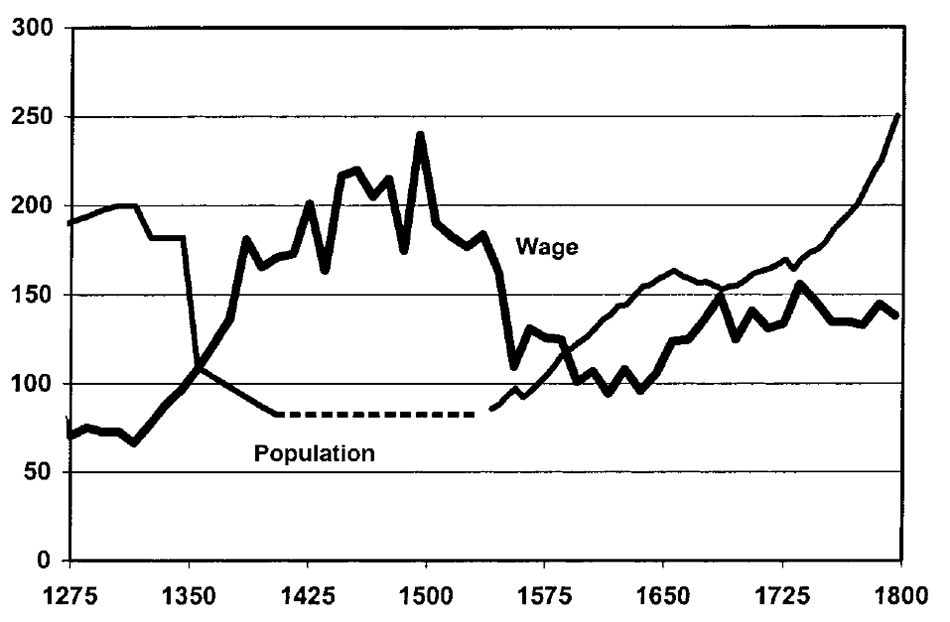
Population and wage levels in Britain before and after the Black Death. Source: Hansen and Prescott (2002)
In fact, it is generally agreed in economic history such as Madison and Clark that in the history of more than 1000 years before the Industrial Revolution, the average output, income and consumption of all mankind were hovering at a very low level, which is the so-called Malthusian trap. In this trap, the increase of population will inevitably lead to involution, and only natural disasters, plagues and wars can temporarily break the involution.
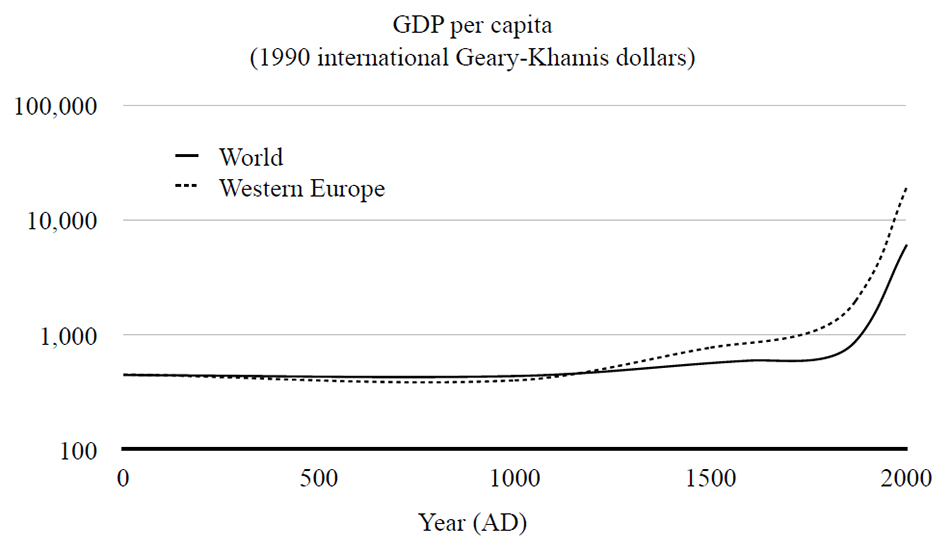
The average income of mankind in the past 2000 years. Source: Wu, Lemin (2015)
Only when the industrial revolution and the tide of urbanization come will mankind have the opportunity to completely break the involution. Compared with agriculture, the vast majority of assets needed for industrial production can be increased in total, and the dependence on unchangeable inputs such as land is much lower. Therefore, if there are more workers, more machines can be produced to match them. With the progress of science and technology, the cost of production machines has been declining, and the means of production used by each worker can be continuously increased, thus making the average output of each worker continue to rise in the long run.
In the post-industrial era, the importance of service industry and innovation is becoming more and more important. Population density is no longer a factor limiting per capita income, but can promote productivity. Service industry depends on face-to-face communication between producers and consumers, and innovation depends on the gathering of talents. A large number of studies in urban economics show that the higher the population density, the higher the productivity and per capita income. This is not a simple correlation, and it is not only because people with high ability choose big cities, but also because of the positive spillover brought by population agglomeration.
Malthus’ logic is still powerful in explaining the gap between the rich and the poor in today’s world. If we rank the countries in the world according to their per capita income, we will find that the difference in per capita output between the top 10% and the bottom 10% countries is more than 20 times. If we divide each country into agriculture and non-agriculture, we will find that the gap between countries in the agricultural field is particularly large. The difference in per capita output between the top 10% countries and the bottom 10% countries in the non-agricultural sector is only about 5 times, while the difference in the agricultural sector is more than 40 times.
Unfortunately, for various reasons, these poor countries put most of their labor force in the particularly underdeveloped agricultural sector, while developed countries usually have only 2%-5% agricultural labor force. If we further decompose the difference in average agricultural output between poor countries and rich countries, we will find that the difference in per mu yield is usually 2-4 times, while the difference in land scale operated by farmers per capita is much more important. For example, the average agricultural land in African countries is usually only about 1 hectare, while the average agricultural land in many countries in Europe and America can reach more than 100 hectares. It is important to increase the yield per mu, but what is more important is how to liberate a large number of farmers from the inefficient agricultural sector through urbanization and industrialization, so that the remaining farmers can manage more land.
Today’s involution is also inseparable from the word "agriculture"
After 40 years of industrialization and urbanization in China, agricultural GDP has accounted for less than 10% of the total GDP, and the resident population in cities has exceeded 60% of the total population. Today, why is the word involution suddenly popular? This is, of course, directly related to the slowdown in economic growth and the anxiety caused by the epidemic. But on closer examination, I’m afraid the root is still a word "agriculture".
First, China is still a dual economy with a huge agricultural and rural population. In terms of employed population, there are still more than 20% farmers in China; In terms of registered population, China still has more than 50% rural population. Because of the lack of public services and other reasons, more than 200 million migrant workers have not really integrated into the city and are trapped in a dilemma between urban and rural areas. At the same time, the difference between urban and rural per capita income in China has been maintained at about 3 times for a long time.
According to Lewis’s dual economic theory, when there is a huge low-income group in rural areas, the income of workers in urban departments will be greatly under downward pressure. One of the most concerned events of last year was also cited as a typical case of "involution" by public opinion, that is, urban takeaway workers constantly violated traffic rules and even paid the price of blood driven by platform algorithms. At that time, the urban middle class and intellectuals who saw the report were surprised: why should they endure the exploitation of the platform? Why don’t they leave? The cruel reality is that they have no better choice. Besides, they don’t do it, and some people do it. Of course, how to ensure the safety of employees is an unshirkable responsibility of enterprises in a normal society.
Secondly, China’s industrialization and urbanization were completed in just 40 years. Therefore, in many fields, although our bodies have entered the post-industrial cities, our heads are still stuck in the agricultural society in the 19th century. In the long agricultural era, our nation has evolved a set of social norms, cultural customs and systems that are suitable for agricultural production. These are deeply branded into the spirit and mind of our nation and will not be automatically eliminated because of the arrival of industrialization and urbanization.
Anyone who has experienced primary and secondary education in China can feel the closure and involution of the whole system: endless questions, endless repeated investment, premature germination of competition among students and lack of cooperation spirit. It is clear that the root of all this is the baton of primary and secondary education-the college entrance examination, which is a variant of the imperial examination system in the agricultural era: there are so many places for juries, and your classmates learn more, which means that your chances of winning the exam are less. If you can’t squeeze into the wooden bridge of the college entrance examination, it means that you have become a waste of the education system. The only way to break this involution situation is to develop truly high-quality vocational education, so that every child can run on the track that suits him or her, so that there is no waste in education.
Even the winner under this system, his personality and way of thinking have been reshaped by this system, and he has been made into a so-called "problem solver". The competitive environment faced by the problem writers since childhood has clear boundaries and definite contents (textbooks and examination syllabus), clear judgment standards (standard answers) and higher arbitrators (examiners and examination institutes). Therefore, the inward search, the pursuit of stability and certainty can be said to have been engraved into their cultural genes since childhood. All this is highly compatible with the working environment of "996". However, the real innovation activities in the market economy are highly uncertain, which requires us to constantly challenge and break the existing knowledge boundary. As economist Knight said, only uncertainty is the real source of profit.
A real source of the "involution" anxiety and panic that young people feel now is the great pressure to settle down in big cities. This is due to the unreachable housing prices in big cities. And the expensive housing prices in big cities stem from the expensive land prices in big cities. Is the land price in big cities expensive because they really lack land? Not so (see my essay Why Houses in Big Cities Are So Expensive, School of Business, 2020-09-03). Different from agricultural land, urban land is highly flexible. It can plan more houses inside or expand outside, and the total amount is not fixed. The real problem is that, through various planning, we have turned an originally variable element into an immutable element, artificially creating a local "involution".
At this point, readers have probably seen that the so-called involution is nothing more than eight words: small-scale peasant economy and small-scale peasant thought.
(The author Xi Xican is an assistant professor at the School of Economics of Fudan University, with a doctorate in economics)