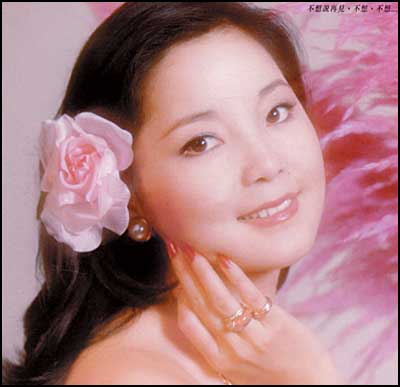
Chinese fans hold commemorative activities to commemorate the 10th anniversary of Teresa Teng’s death.
Today is the 10th anniversary of the death of the famous singer Teresa Teng, and the Chinese community has used various activities to commemorate this "queen of a generation". Among them, Teresa Teng Cultural and Educational Foundation of Taiwan will hold a memorial and tracing tour of "Feeling Teresa Teng" and hold a music dinner.
According to Taiwan Province media reports, fans from Taiwan Province and Hongkong have to pay NT$ 2,500 for the memorial service, tracing trip and evening singing dinner in the "Yunyuan" in Jinbaoshan, and NT$ 2,000 if they only attend the singing dinner.
In addition, Teresa Teng’s younger brother Deng Changxi, the chief executive of the Foundation, said that a special area for Teresa Teng was planned in Guilin that day, with a Teresa Teng Music Garden and buildings modeled after the former residence and interior furnishings of Teresa Teng, Hong Kong. It is expected that it will be open to the public in May next year. On the other hand, the Chinese channel of Hong Kong Phoenix Satellite TV broadcasted a 150-minute documentary "Ten Zhou Nianji in Teresa Teng" at 8 o’clock every night from May 2 to 6. At 9 o’clock last night, ATV also broadcasted a special feature "The Whole City misses Teresa Teng" to review Teresa Teng’s life story.
In Shanghai, "Ten Years of Thinking of Your Majesty-Shanghai Concert of Teresa Teng’s Golden Melody of Fanghua 18th" was held in He Luting Concert Hall on the evening of May 6th and 7th. A female student from Chongqing who looks like Teresa Teng in voice and expression performed as a mysterious successor. It is reported that after the performance in Shanghai, the commemorative concert will also be performed in Changzhou, Nanjing and Hangzhou.
In addition, the reporter also learned that the musical "I wish people a long life", which reflects Teresa Teng’s life, is also in preparation. Now, Li Xinjie, a young actor, has been decided to play Teresa Teng, and many mainland actors are actively contacting the crew to play the role, but the crew has not yet determined the specific candidate. At the same time, the crew is also considering promoting the musical to the mainland. (comprehensive)
Thinking of Teresa Teng and the Sound of Decadence
In 1982, Teresa Teng’s songs spread to the mainland, not through radio waves, but through hard channels such as tapes and records. At that time, "When will you come again" was once popular, and its criticism was also once popular. When I was in Grade Three, I once saw an angry poem by an old poet in the newspaper. The poem begins with a young man with long hair and bell-bottoms listening to "When I Will Come Again", and sadly recalls a "real" plot in War of Resistance against Japanese Aggression: in a terrible battle, Japanese imperialist bombers dropped not bombs on China’s desperately defending troops, but records all over the sky, with showy singers printed on them, and the song in the record is this "When I Will Come Again"!
Out of moral sense, I didn’t take the initiative to listen to Teresa Teng. At that time, as a high school student, I couldn’t say that my moral sense represented the mood of the whole society, but it undoubtedly represented the index of orthodox morality at that time. But for people at that time, those songs were really exciting and made people blush and jump. I think "Don’t pick wild flowers by the roadside" is a rogue song; However, Sweet Honey, A Thousand Words and The Moon Represents My Heart are yellow enough. You know, such things as love, kissing and being in love were extremely private and even taboo at that time, but the story of a small town was a different story, which made me reflect: a yellow singer could sing truth, goodness and beauty!
I was able to accept Teresa Teng’s songs normally after I went to college (1985). In 1987, the national regular audio-visual publishing house also began to introduce Teresa Teng songs. In 1988, the taste of love made me feel Teresa Teng’s power to erode people’s bone marrow, which was also the beginning of my real experience of the corrosive power of the word "decadent voice": it didn’t give you strength, only let you sink blindly. After several years of reform and opening up, secular life and emotion have regained their seats in the social value system, and the era of only national ideology without personal happiness has passed.
In an era when ideology is as solid as iron, Teresa Teng made us realize that revolution is not necessarily violence and bloodshed, and the weakest thing is sometimes stronger than revolution. On May 8, 1995, Teresa Teng died. A number of mainland rock bands and artists, such as Tang Dynasty, Panther and Zheng Jun, once admitted the influence of Teresa Teng on them with a series of Farewell Rock, and put Teresa Teng in the position of enlightener.
So what exactly is Teresa Teng? I think that if "decadent voice" is a neutral word, Teresa Teng is indeed a very outstanding representative of "decadent voice". From the content, she is an excellent spokesperson for China’s secular life and gender feelings, and an extreme expression of the emotional world. This soft and lingering private world, from the Song Dynasty to the Qing Dynasty, is deeply immersed and intoxicating. From the perspective of singing art, Teresa Teng is very China, and he is the pinnacle of the traditional little girl singing in China. She is not unprecedented-from the poetry and singing skills and opera tunes a hundred years ago to the Shanghai pop songs, Bai Guang and Zhou Xuan in the 1930s, Teresa Teng is actually their successor, whose pronunciation, charm and emotional sustenance are all in the same strain. She is not peerless-indeed, Deng’s singing is so perfect that no one dares to speak again in 30 years; Under the pressure of Teresa Teng’s 100 million records and more than 1,000 songs, it seems that Deng died, and there is no new way to learn from Deng. However, I believe that within 20 years, there will be new descendants who will continue Deng’s vocal cavity. As one of the main veins of China tradition, it has no reason to stop and will not stop.
Love Teresa Teng’s younger brother remembers his sister’s two feelings.
Not long ago, Lu Yu, a reporter from Phoenix TV, interviewed Teresa Teng’s younger brother Deng Changxi. He said that although he felt that Teresa Teng was unhappy all his life, he thanked so many people for caring about Teresa Teng. In the meantime, he talked about Teresa Teng’s emotional world, which was rarely made public.
Jackie Chan: I missed it because I was young.
In 1979, 26-year-old Teresa Teng came to the United States from Japan. In Los Angeles, Teresa Teng had a long contact with Hong Kong artist Jackie Chan, who was also filming in the local area. From an old friend in another country to a lover, the two experienced a tortuous love story.
Deng Changxi: They met in America. The troupe often comes to our house.
Lu Yu: Were you in favor of them being together?
Deng Changxi: I don’t agree. I think Jackie Chan is too thick. He was a martial arts star at that time. My mother has no problem.
Lu Yu: But you think your sister is really into this relationship.
Deng Changxi: In fact, she is very devoted to every relationship. She is quite persistent in her feelings.
Lu Yu: Yes, Jackie Chan said that he regretted it at that time, thinking that he was very young at that time and didn’t know how to deal with a relationship. But at that time, you thought that two very young people were very famous and it was very difficult to get together.
Deng Changxi: Both sides are busy. They are also busy making movies. As far as I know, their feelings are also good. My sister also held a kind of psychology of seeing each other, and later found out that the other party was very masculine, and she hated the kind of male chauvinism.
Lu Yu: The two of them, who proposed to break up?
Deng Changxi: No one mentioned it either. Anyway, it’s just the deviation of some concepts, which are different, and then they broke up in discord and gradually lost contact.
Guo Kongcheng: Separated by secularism.
Faced with the inevitable peach affair and uninterrupted rumors, Teresa Teng always chooses an attitude of neither admitting nor denying. It was not until Guo Kongcheng, the chairman of Shangri-La Group, appeared that Teresa Teng let go for the first time and admitted that Guo Kongcheng was the only thrill. On the evening of October 28th, 1981, they held an engagement ceremony.
Lu Yu: It seems that this is the only relationship that she admits to the outside world.
Deng Changxi: Yes, she is more serious, and she is wearing an engagement ring.
Lu Yu: Did that boy visit your parents before?
Deng Changxi: Yes, my parents like him very much, and we are all happy to make this happen.
Lu Yu: Did they ask her, "If you marry into our house, you can’t sing any more"?
Deng Changxi: Actually, she didn’t want to sing at all. With her personality, she will teach her husband and children and then give up all performance activities, but she can’t accept this as a condition. She said, running a hotel is a career, and so is singing. Why should I give up mine?
Lu Yu: At this stage, does your sister feel a little tired when she sings?
Deng Changxi: At that time, in fact, her career was in full swing, it was the best time, and she didn’t feel tired, but she was already preparing to bid farewell to the music world.
At the end of 1982, a year after her engagement to Guo Kongcheng, Teresa Teng decided to call it quits. After a marriage, there is no separation.
Lu Yu: It’s a pity that she may be that close to that marriage.
Deng Changxi: Yes. So if she gets married, she will be a good wife and a good mother.
Lu Yu: Do you think she will be happy in this life?
Deng Changxi: I don’t feel very happy, but she has experienced something that many people can’t, so it’s worth it. Then it’s worth it that so many people love her. (End)